.png)
Smart Monitoring Systems for Pharmacies and Laboratories
One failed refrigerator can undo months of careful work. A vaccine fridge left outside range overnight, a laboratory freezer with a loose seal, or a medicine cooler affected by a power fault can turn valuable stock into waste before anyone opens the door in the morning.
For pharmacies, clinics, pathology rooms and laboratories, temperature control is not a background task. It protects patients, preserves product integrity, supports accreditation and keeps avoidable losses under control. Manual temperature checks still have a place, but they are no longer enough on their own for many sites.
Smart monitoring systems give teams a clearer, faster way to watch storage conditions. They track temperature continuously, send alerts when something goes wrong and create records that help demonstrate care and compliance.

Product safety depends on more than a working fridge
A medical refrigerator can feel reliable until it is tested by real conditions. Doors open and close throughout the day. Stock arrives warmer than expected. Staff rotate products. Ambient room temperature changes. Power supply issues occur. A compressor ages. A door seal weakens.
Any one of these can push medicines, vaccines, reagents or samples outside their required range.
For many products, the approved storage range is narrow. Some items must remain refrigerated, others must be frozen, and some must avoid freezing even for a short period. Once storage instructions are breached, staff may need to quarantine the stock, contact the manufacturer or discard it. That can be expensive, disruptive and stressful.
A smart monitoring system helps by catching problems early. Instead of discovering an issue during a scheduled manual check, the system can alert the right person while there is still time to act.
That might mean:
Closing a fridge door that was left ajar
Moving stock into a backup refrigerator
Calling maintenance before a freezer fails completely
Checking a temperature excursion before products are used
Documenting the event for review and audit purposes
The main value is not just the reading itself. It is the speed and reliability of the response.
Manual checks leave gaps that technology can close
Traditional temperature logs often rely on staff recording readings once or twice a day. This appears simple, but it has weaknesses.
A fridge might drift out of range at 8 pm and return to range by 8 am. A morning manual check would look normal, even though stock may have been affected for hours. A staff member may forget a reading during a busy dispensary period. A paper log may become hard to read, misplaced or filled in after the event.
These are common human problems, not signs of poor intent.
Smart monitoring creates a more complete record. Sensors collect readings at set intervals and store them automatically. If readings move outside the accepted range, the system can send an alert by SMS, email, app notification or another channel, depending on the setup.
The result is a stronger chain of evidence:
Manual temperature checks | Smart monitoring systems |
Readings taken at set times by staff | Readings captured continuously or at frequent intervals |
Paper or spreadsheet records | Digital records with timestamps |
Problems found during checks | Alerts sent when limits are breached |
More risk outside business hours | After-hours alerts can be escalated |
Harder to review trends | Historical data can show patterns |
Manual checks may still form part of local procedures, especially where required by policy. The difference is that the monitoring system reduces blind spots.
What smart monitoring systems actually track
A good system does more than display the current temperature. It builds a picture of storage conditions over time. That matters because cold storage problems often develop gradually.
A pharmacy refrigerator may start to run a little warmer each week. A freezer may take longer to recover after the door has been opened. A cooler in a laboratory prep room may rise above range on hot afternoons. These patterns can be missed without historical data.
Common monitoring points include:
Refrigerator temperature
Freezer temperature
Ambient room temperature
Humidity, where relevant
Door openings
Power status
Sensor battery level
Network connection status
Not every site needs every feature. A small rural pharmacy may need monitored vaccine fridges and escalation alerts. A larger laboratory may need multiple freezer zones, calibration records, audit access and reports across several storage rooms.
The best setup depends on the products being stored, the number of storage units, risk level, staffing patterns and compliance needs.

Alerts need to reach the right person at the right time
Temperature monitoring only works if alerts lead to action. A system that sends all alarms to one inbox may fail when that person is on leave, in transit or asleep. Alert design should match real workflows.
A useful escalation plan answers several questions:
Who receives alerts during trading hours?
Who receives alerts after hours?
How long should the system wait before escalating?
What happens if the first person does not respond?
Which events need immediate action?
Which events need review during normal hours?
For example, a short fridge door opening during a busy morning may not need the same response as a freezer warming steadily after midnight. A well-planned system lets teams set thresholds and escalation paths that reflect product risk.
Good alerts are specific. They should identify the storage unit, the current temperature, the threshold breached and the time of the event. Vague warnings slow people down.
An alert such as “Fridge 2 temperature is 9.1°C, above the high limit of 8°C, recorded at 11:42 pm” is much more useful than “Temperature alarm”.
The message should also support the next step. Some organisations include short response instructions in their procedures, such as checking the door, confirming power supply, moving stock to backup storage or recording corrective action.
Compliance records should be ready before an audit
Pharmacies and laboratories operate under layers of expectations. In Australia, these may include manufacturer storage instructions, professional standards, accreditation requirements, cold-chain procedures, state or territory rules and relevant national guidance. Laboratories may also need records that support quality systems and sample integrity.
This article is general information only and does not replace regulatory, legal or quality advice for a specific organisation.
Smart monitoring systems help because they keep records in a consistent format. Instead of searching through paper binders, staff can review time-stamped data, alarm history, acknowledgement records and corrective actions.
A strong record set may include:
Temperature history by unit
Alarm events and durations
Staff acknowledgement times
Corrective actions taken
Sensor calibration information
Maintenance notes
Reports for selected date ranges
This matters during audits, internal reviews and incident investigations. If a fridge went out of range, the question is not only “What happened?” It is also “How quickly was it detected, what action was taken, and what evidence supports the decision?”
Clear records protect the organisation and support safe decision-making.
Stock loss can be more expensive than the monitoring system
Spoilage is not just the value printed on an invoice. The real cost can include emergency replacement stock, cancelled appointments, delayed testing, staff time, courier costs, patient recalls, investigation work and damage to trust.
For smaller clinics and laboratories, a serious cold storage failure can create a financial shock. For larger organisations, repeated minor incidents can quietly drain budgets.
Monitoring helps reduce waste in three ways.
It gives teams more time to intervene
Early alerts can turn a major stock loss into a minor incident. If a refrigerator warms because a door is not fully closed, a quick response may protect the contents.
It reveals weak equipment before failure
Temperature trends can show that a unit is struggling. Longer recovery times, repeated alarms or warmer readings at certain times of day may point to a maintenance issue.
It reduces uncertainty after an event
When records are complete, staff can make better decisions about whether stock stayed within acceptable limits. Without data, organisations may have to discard products because they cannot prove conditions were safe.

Choosing a monitoring system for pharmacy and laboratory storage
The right system should match the level of risk. A cheap device that only shows the current temperature may suit a non-critical area, but it is not enough for high-value medicines, vaccines, reagents or irreplaceable samples.
When comparing systems, focus on practical requirements rather than impressive feature lists.
Check sensor accuracy and calibration support
Sensors should suit the storage range and application. Refrigerated medicines, ultra-low temperature freezers and ambient storage zones have different needs. Ask how calibration is handled, how often it is required and how certificates are stored.
Confirm data logging during outages
Power and network failures are exactly when records matter. A suitable system should keep logging data if the internet drops out and upload it when the connection returns, depending on its design.
Review alert options
SMS may be more visible after hours than email. App notifications may work well for some teams. Larger organisations may need escalation chains, alarm acknowledgements and role-based access.
Make reporting simple
Staff should be able to generate reports without wasting time. A report should clearly show readings, exceptions and response history for the selected period.
Look for clear user permissions
Not every staff member needs the same access. Some may only need to view current readings. Managers or quality leads may need reporting, alarm settings and audit functions.
Plan for multiple sites
If an organisation has several locations, central visibility can help compare conditions, spot repeated issues and support consistent procedures across the group.
Installation works best when it follows the workflow
Technology alone does not fix poor processes. Successful monitoring depends on good placement, staff training and clear procedures.
Sensor placement matters. A probe placed too close to a cooling vent, door or wall may not represent actual product conditions. Some sites use buffered probes to better reflect the temperature of stored products rather than short air temperature changes. The right choice depends on the storage purpose and local requirements.
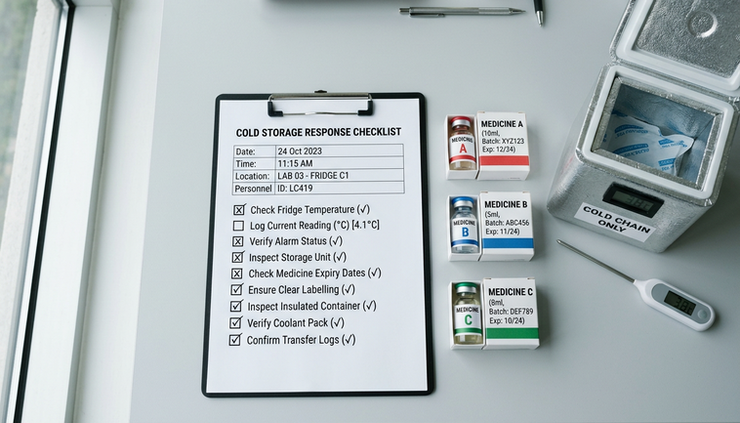
Staff also need to know what to do when an alert arrives. A simple alarm response guide can prevent confusion, especially after hours.
A practical response process might include:
Check the alert details and storage unit.
Confirm whether the door is closed and power is available.
Move stock if required by the procedure.
Record the action taken.
Quarantine affected products if the excursion may be significant.
Seek manufacturer or quality advice before returning stock to use.
Training should include casual staff and new starters. Temperature control cannot rely on one person who knows the system well.
Common mistakes that weaken monitoring
Even a good system can fail if it is poorly managed. Several problems appear again and again in cold storage environments.
Alarm fatigue
If thresholds are too tight or alerts are poorly configured, staff may receive too many notifications. Over time, people stop treating alarms as urgent. Thresholds should protect products but still reflect normal operation.
No after-hours owner
A system may detect a problem at 2 am, but that only helps if someone responds. Escalation paths need to be clear and tested.
Unclear corrective action records
Acknowledging an alarm is not the same as resolving it. Records should show what was checked, what was moved and who made the decision.
Sensors placed for convenience
A sensor attached near the front of a fridge may be easy to reach, but it may not reflect the condition of stored stock. Placement should follow the monitoring plan.
Reports that nobody reviews
Historical data can show recurring risk, but only if someone looks at it. Regular review helps pick up equipment issues before they become expensive failures.
Smart monitoring supports better cold-chain decisions
Cold-chain management is part equipment, part procedure and part culture. A smart system supports all three. It watches storage conditions when staff are busy or away. It gives early warnings before small issues become expensive losses. It creates records that help teams explain what happened and what they did about it.
For pharmacies and laboratories, the goal is simple: protect products, reduce waste and support compliance without adding unnecessary work. Smart Monitoring Systems for Pharmacies and Laboratories make that goal easier to achieve when they are chosen carefully and backed by clear procedures.
The best next step is to review the storage units that carry the greatest risk. Check what is stored, what evidence is currently kept, who receives alarms and how staff respond after hours. Any weak point in that chain is a good place to improve.


