.png)
Smart Monitoring Systems to Boost Restaurant Efficiency and Success
A busy service can hide a lot of small losses. A coolroom door left ajar for 20 minutes. A freezer running warm overnight. A dishwasher using more power than it should. Prep fridges checked on paper but not checked often enough. None of these problems feels dramatic in the moment, but together they can eat into already thin restaurant margins.
Foodservice is growing, yet running a restaurant remains one of the toughest small business challenges. Widely cited industry estimates suggest many restaurants do not survive beyond their first few years. The exact number varies by market and model, but the message is clear: success depends on using time, labour, stock, energy, and equipment well.
Smart monitoring systems give operators a clearer view of what is happening in the kitchen, back of house, and storage areas. They do not replace good staff, food knowledge, or strong service. They help teams catch problems earlier, reduce waste, and make better day-to-day decisions without adding more paperwork.

Why restaurants need better visibility
Restaurants run on narrow tolerances. Food needs to stay at safe temperatures. Staff need to complete prep before service. Equipment needs to work when the rush starts. Stock needs to move fast enough to stay fresh, but not so fast that the kitchen runs short.
When information sits in notebooks, memory, or guesswork, managers often learn about problems too late.
A smart monitoring setup can track key conditions automatically and send alerts when something falls outside the expected range. That might include a text message when a freezer temperature rises, a dashboard that shows energy use by area, or a record of when a coolroom door stayed open too long.
This matters because restaurant pressure builds in layers:
Food waste cuts directly into profit.
Equipment failure can stop trade for a shift or longer.
Energy costs rise when appliances work harder than needed.
Manual checks take time and can be missed during peak periods.
Compliance records become harder to verify when they rely only on paper.
Smart Monitoring Systems to Boost Restaurant Efficiency and Success work best when they focus on the real pain points of a venue, rather than collecting data for its own sake.
What smart monitoring systems can track
The best systems start with practical questions. Is the food safe? Is equipment working? Are resources being wasted? Is the team spending time on checks that could be automated?
Temperature and food safety
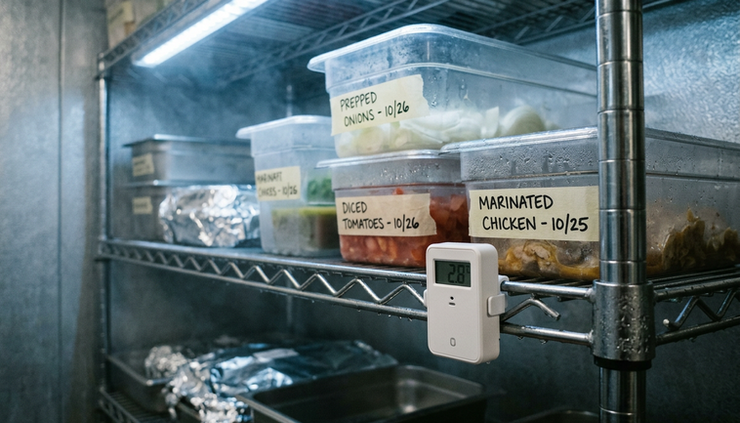
Temperature monitoring is one of the most useful starting points for foodservice. Wireless sensors can sit in coolrooms, freezers, display cabinets, under-bench fridges, and delivery holding areas.
They can record temperatures at regular intervals and alert staff if readings move outside set limits. This helps protect perishable stock and supports food safety records.
For example, if a freezer begins warming at 2 am, the right alert may give staff time to move stock before it is lost. Without that alert, the problem may only appear when the first person arrives in the morning.
Temperature records can also support HACCP-style processes and local food safety expectations. Automated records do not remove the need for staff checks, but they make gaps easier to see.
Equipment performance
Commercial kitchens depend on equipment that takes a beating every day. Fridges, freezers, ovens, dishwashers, exhaust systems, coffee machines, and ice machines all affect service.
Monitoring can help identify signs of strain, such as:
A fridge compressor cycling too often
A freezer taking longer to recover after door openings
A dishwasher drawing unusual power
An exhaust fan not running during expected hours
A coolroom door being opened repeatedly during service
These signals do not always prove a fault, but they point to areas worth checking. A technician called early may be cheaper than emergency repairs and lost trade.
Energy use
Energy is a major cost in restaurants, cafés, bakeries, pubs, and takeaway venues. Appliances run for long hours, often in hot spaces. Small inefficiencies add up fast.
Smart plugs, meters, and appliance monitors can show where energy is being used. Once a venue can see patterns, it becomes easier to act.
A simple example is equipment left on after close. Another is refrigeration working harder because seals are damaged, coils are dirty, or doors are left open. Monitoring helps link the cost to a cause.
Water and leak detection
Leaks are easy to miss in kitchens because water is already part of the environment. A slow leak under a dishwasher or behind a bar can damage flooring, cabinetry, and equipment.
Water sensors can sit near dishwashing areas, ice machines, sinks, grease traps, and storage spaces. Alerts can help teams act before a small leak becomes a shutdown.
Stock movement and storage habits
Not every restaurant needs full inventory automation. Many can benefit from lighter monitoring that supports better storage habits.
Door sensors, temperature logs, and shelf-life reminders can help managers see how often storage areas are accessed and whether handling practices match expectations.
For higher-volume venues, connected scales, barcode systems, or inventory tools may help track usage. The aim is not to watch every ingredient for the sake of it. The aim is to reduce surprise shortages and avoid over-ordering.
The real gains come from small, steady improvements
Smart monitoring does not need to be complex to be useful. Many gains come from fixing repeated small problems.
A restaurant might learn that staff open the main coolroom far more often during service than expected. The fix could be a better mise en place fridge on the line. A café might find that a display cabinet struggles every afternoon because sunlight hits the glass. The fix could be shade, repositioning, or maintenance.
The value is in the pattern, not just the alert.
Area monitored | Common issue | Practical improvement |
Coolrooms and freezers | Temperature rises after hours | Move stock, service equipment, or repair seals earlier |
Dishwashers | High energy or water use | Check cycles, filters, heating elements, and staff habits |
Prep fridges | Slow recovery after service rush | Reduce door openings or review fridge placement |
Dry storage | Stockouts or over-ordering | Match orders to actual usage patterns |
Waste bins | Excess plate waste or prep waste | Adjust portions, prep volumes, or menu items |
The best results usually come when managers review the information weekly. Daily alerts solve urgent problems. Weekly patterns improve the business.
How monitoring supports staff instead of burdening them
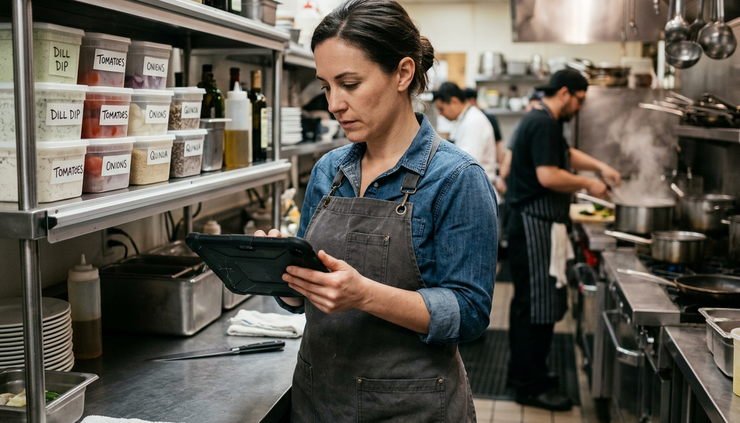
Technology fails when it feels like one more task. In foodservice, staff have little patience for tools that slow them down during service. A monitoring system should remove friction, not add it.
Good systems help staff by:
Reducing repetitive manual checks
Sending clear alerts to the right person
Keeping records in one place
Making faults easier to explain to technicians
Showing managers where training or layout changes would help
The wording of alerts matters. “Freezer 2 above limit for 15 minutes” is useful. A vague warning that needs investigation during a rush is not.
The system should also respect staff. Monitoring equipment and process conditions is different from building a workplace that feels watched in every movement. Focus on food safety, maintenance, waste, and resource use. Be clear with staff about what is being monitored and why.
When teams understand that alerts prevent stock loss, after-hours callouts, and stressful service failures, adoption becomes easier.
Choosing a low-cost connected setup
A restaurant does not need to install every possible sensor at once. A staged approach is often better. Start with the risks that can cause the biggest loss or disruption.
For many venues, that means refrigeration first.
Start with the highest-risk areas
Look at the areas where one failure could hurt the business quickly. Common priorities include:
Walk-in coolrooms
Freezers
High-value protein storage
Display cabinets
Prep fridges used during service
Ice machines
Dishwashing and leak-prone areas
A small number of well-placed sensors can create more value than a large system nobody reviews.
Check connectivity before buying
Commercial kitchens can be difficult environments for wireless devices. Stainless steel, thick walls, cold rooms, and distance can affect signal strength.
Before investing widely, test devices in the real location. A sensor that works in the dining room may not work inside a coolroom unless the system uses a suitable gateway or network.
Ask practical questions:
Will the sensor work in cold and humid conditions?
How long do batteries last?
What happens during an internet outage?
Can alerts go to more than one person?
Can records be exported for audits or internal reviews?
Is the dashboard simple enough for managers to use quickly?
Keep alerts tight
Too many alerts create alert fatigue. Staff start ignoring them if they receive constant low-value messages.
Set sensible thresholds. Use time delays where appropriate. A fridge door opened briefly during service should not trigger the same alert as a freezer warming for 30 minutes.
A strong setup has levels:
Immediate alerts for urgent food safety or equipment risks
Daily summaries for issues that need attention soon
Weekly reports for trends and planning
This keeps urgent problems visible without turning the system into noise.
Turning monitoring data into better decisions
Data only helps when it leads to action. A dashboard full of charts is not enough. The restaurant needs a rhythm for reviewing and responding.
A simple weekly review can cover four questions.
What went wrong this week
List the alerts that mattered. A freezer warning, a leak alert, or a repeated temperature issue should be discussed while the details are fresh.
The goal is not blame. The goal is to ask what caused the issue and how to prevent it.
What keeps repeating
A one-off alert may not matter. A repeated pattern usually does.
If the same prep fridge warms every Friday night, the issue could be service volume, door openings, stock loading, or equipment wear. Patterns point to better fixes than guesses.
What can be changed this week
Choose small changes. Move high-use items closer to the line. Replace a fridge seal. Adjust the close-down checklist. Ask a technician to inspect an appliance before it fails.
Small weekly fixes build stronger operations over time.
What should be measured next
Once the first risks are under control, add monitoring where it can answer a clear question.
For example:
Are energy costs rising because equipment runs after close?
Is food waste linked to overproduction on quiet days?
Are delivery holding areas staying within range?
Is a display cabinet safe during hot weather?
This keeps the system focused on business needs.
Common mistakes to avoid
Smart monitoring systems can fail when the rollout is rushed or poorly matched to the venue. The technology may be useful, but the setup needs care.
Buying too much too soon
A large system can look impressive and still solve very little. Start with the core risks, prove the value, then expand.
Ignoring staff workflow
A system that requires staff to log in during service, interpret complex charts, or silence frequent alerts will not last. Keep the process simple.
Treating data as proof without context
A temperature spike may be caused by a door opening, a delivery, a sensor placement issue, or a real equipment fault. Use data as a signal, then confirm the cause.
Forgetting maintenance
Sensors need battery checks, cleaning, calibration where required, and occasional testing. Add these tasks to the regular maintenance schedule.
Leaving alerts with one person
If only one manager receives an urgent alert, the system has a weak point. Use escalation rules so someone else is notified if the first person does not respond.
A practical rollout plan for restaurants
A good rollout can be simple.
Map your risks
Walk through the venue and list the areas where failure would cost the most. Include food safety, equipment, energy, water, and stock.
Choose the first use case
Pick one clear problem, such as freezer monitoring or coolroom temperature records. Define what success looks like.
Test in real conditions
Install a small number of sensors and check signal strength, battery performance, alert speed, and usability.
Set alert rules
Keep thresholds practical. Decide who receives alerts, who responds, and when escalation happens.
Train the team
Show staff what the system does, what it does not do, and how it helps the venue. Keep training short and practical.
Review weekly
Look at alerts, patterns, and fixes. Turn information into maintenance tasks, layout changes, or ordering improvements.
Expand only when useful
Add more sensors or tools when there is a clear reason. Growth should follow proven value.

The bottom line for foodservice operators
Restaurants succeed through hundreds of small decisions made well. Smart monitoring helps by making hidden problems visible, especially in refrigeration, equipment performance, energy use, leaks, and storage habits.
The strongest systems are not the most complicated. They are the ones that answer real questions, alert the right people, and fit into the daily rhythm of the kitchen.
Start small. Measure the areas where failure would hurt most. Use the information to reduce waste, protect stock, support staff, and keep service running. In a tough industry, that extra visibility can make a real difference.


