.png)
Choosing the Right Industrial Monitoring Architecture Monnit Dragino Acrel PLC and Hybrid Systems
A monitoring system can look simple on a drawing and still fail in the field. The sensor may be right, but the radio path may be wrong. The dashboard may look useful, but the data may not be trusted by maintenance. The control system may already have the value, but no one has made it visible.
That is why industrial monitoring should start with the architecture, not the product catalogue.
Monnit/iMonnit, Dragino/LoRaWAN with ProSight, Acrel/Modbus, and PLC/HMI/VSD systems all solve real problems. They suit different distances, data types, response times, budgets, and site conditions. The best choice is rarely about which system is “best”. It is about which one fits the job with the least friction.

Start with the monitoring requirement, not the brand
Before choosing hardware, ProSense would usually separate the monitoring task into a few plain questions.
What needs to be measured?
How often does it need to update?
What happens if the value is missed?
Is the equipment fixed, mobile, remote, or inside a switchboard?
Does the site already have PLCs, meters, drives, or SCADA?
Does the system only need alerts, or does it need reporting and trending?
Will the system ever control equipment, or only watch it?
These questions often point to the architecture faster than a long feature comparison.
For example, a cool room door sensor and a main switchboard power meter are both “monitoring”. They do not need the same system. One may need fast installation and simple alerts. The other may need wired metering, Modbus mapping, and long-term energy reporting.
The same applies across factories, water sites, farms, depots, cold storage, workshops, and large industrial facilities. Different assets deserve different monitoring paths.
Monnit and iMonnit suit fast wireless monitoring with simple alerts
Monnit is often a good fit when the job is to add monitoring without rewiring a site. Its wireless sensors connect through gateways, and iMonnit provides the cloud platform for viewing data, trends, and alerts.
This approach suits small to medium monitoring tasks where speed of deployment matters.
Common examples include:
Cool rooms and freezers
Doors, hatches, and access points
Temperature and humidity checks
Leak detection
Basic equipment status
Remote sheds, stores, or plant rooms
Simple compliance logs and alerts
The strength of Monnit/iMonnit is its low barrier to entry. A site can often get useful data quickly without touching a PLC, changing a switchboard, or installing long cable runs. That makes it attractive for maintenance teams that need visibility but do not need a full industrial control project.
It also suits assets spread across a site where cabling would cost more than the monitoring value.
The trade-off is that Monnit is mainly a monitoring and alerting system. It is not usually the first choice when the data must become part of a control sequence, safety function, or high-speed process response. It also needs careful thought around gateway location, wireless range, battery management, and data ownership.
ProSense recommendation
Choose Monnit/iMonnit when the requirement is practical condition monitoring, fast alerts, and simple historical records. It is a strong choice for low-risk assets where ease of installation and low site disruption matter more than deep control integration.
Dragino and LoRaWAN with ProSight suit long-range field monitoring
Dragino devices are commonly used in LoRaWAN architectures. LoRaWAN is designed for long-range, low-power communication. It works well for sensors that send small packets of data at set intervals rather than constant high-speed streams.
When paired with a platform such as ProSight, the architecture becomes useful for remote monitoring across broad sites. ProSight can act as the place where data lands, is displayed, and is turned into alerts or trends.
This architecture suits sites where distance is the problem.
Good use cases include:
Water tanks and reservoirs
Farm infrastructure
Bore pumps and irrigation points
Remote gates or sheds
Environmental sensing
Outdoor equipment status
Widely spread industrial yards
Utility and council assets
LoRaWAN can be a good match where mobile coverage is patchy, power is limited, and running cable is not realistic. A sensor can report level, flow, pressure, temperature, or status from a distant point back through a gateway.
The key design work is in the radio planning. Antenna location, gateway height, terrain, buildings, metal structures, forests, and distance all affect the result. A bench test is not enough. Field testing matters.
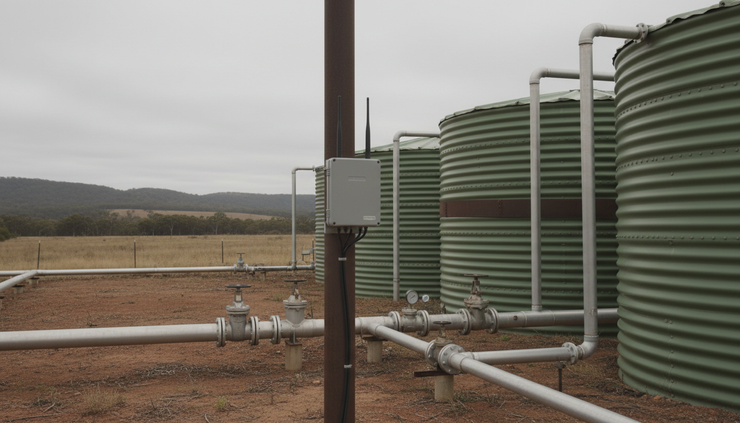
LoRaWAN is not ideal for everything. It is not built for high-speed control, large data payloads, or constant second-by-second readings. It works best when the question is, “What is the current state?” rather than, “Can this system control the process in real time?”
ProSense recommendation
Choose Dragino/LoRaWAN with ProSight when the site has spread-out assets, modest data rates, and a need for practical dashboards and alerts. It is especially suitable where distance, battery life, and cable cost are the main design limits.
Acrel and Modbus suit metering, switchboards, and energy data
Acrel devices are often used for electrical metering and power monitoring. Many Acrel meters and devices communicate using Modbus, a widely used industrial protocol that suits structured data collection from meters, protection devices, and monitoring modules.
This architecture is a natural fit inside or near electrical infrastructure.
Typical applications include:
Main switchboard metering
Sub-circuit energy monitoring
Power quality checks
Demand monitoring
Solar and generator metering
Tenant or department energy allocation
Motor and load monitoring
Electrical fault or alarm visibility
The main strength is that the data is precise, structured, and wired. For electrical monitoring, that matters. Wired Modbus links can provide repeatable readings, clear device addressing, and simple integration into gateways, HMIs, SCADA, or cloud dashboards.
Acrel/Modbus also works well when a site wants to compare energy use across areas. For example, a manufacturing plant may want to see which production line is driving demand during peak periods. A cold storage site may want to separate refrigeration load from lighting, offices, and materials handling.
The design work is different from wireless monitoring. It involves current transformers, meter selection, switchboard space, communications wiring, Modbus addressing, baud rates, registers, and electrical safety. This is not usually a “stick-on sensor” job.
The trade-off is installation effort. Work inside switchboards may need shutdown planning, licensed trades, drawings, testing, and safe access. Modbus also needs careful mapping so the values in the dashboard match the physical equipment.
ProSense recommendation
Choose Acrel/Modbus when the main value is electrical visibility, metering accuracy, and structured data from switchboards. It is a strong option for energy reporting, demand management, and plants that need reliable readings from known electrical points.
PLC, HMI, and VSD systems suit control and high-value process assets
PLC, HMI, and VSD systems sit closer to the heart of industrial control. A PLC reads inputs, runs logic, and controls outputs. An HMI gives operators a local interface. A VSD controls motor speed and often provides useful data such as current, frequency, fault codes, and run status.
This architecture suits assets where monitoring and control are connected.
Examples include:
Pump stations
Conveyor systems
Production lines
Mixing and batching systems
Chillers and compressors
Process skids
Water and wastewater control
Motor control centres
Critical plant interlocks
The strength of PLC/HMI/VSD systems is depth. They can read signals, run sequences, alarm locally, control equipment, and share data with higher-level systems. They are suited to fast response times and critical plant logic.
They also suit sites where operators need clear local control. A cloud dashboard may be useful, but a pump station still needs a local interface when a technician stands in front of it. An HMI can show mode, status, alarms, setpoints, and manual controls without depending on an internet connection.

A PLC-based system also allows controlled integration. It can pass selected values to ProSight, SCADA, historian software, or a building management system while keeping core control local.
The trade-off is cost and engineering effort. PLC systems need design, programming, commissioning, documentation, and ongoing change control. They are not usually justified for a few low-risk temperature points or simple open-close alerts.
ProSense recommendation
Choose PLC/HMI/VSD architecture when the system controls plant, protects production, or needs fast and trusted local operation. It is the right path when the monitoring data must sit close to the process logic.
A side-by-side comparison helps narrow the choice
No table can replace site design, but it can narrow the likely architecture.
Architecture | Best fit | Strengths | Watch points |
Monnit/iMonnit | Simple wireless sensing and alerts | Fast setup, broad sensor range, cloud access, low disruption | Battery planning, gateway coverage, limited control role |
Dragino/LoRaWAN and ProSight | Long-range remote monitoring | Long distance, low power, good for spread-out assets | Radio path testing, lower data rates, not for fast control |
Acrel/Modbus | Electrical and energy monitoring | Structured wired data, strong switchboard fit, useful for reporting | Electrical installation effort, Modbus mapping, shutdown planning |
PLC/HMI/VSD | Control systems and critical assets | Local control, fast response, operator interface, drive data | Higher engineering cost, change control, project planning |
Hybrid systems | Large facilities with mixed asset types | Matches each asset to the right method, supports staged growth | Needs clear data design, naming standards, support model |
The key point is balance. A plant may need more than one architecture because the plant itself contains more than one kind of problem.
Hybrid systems make sense in large industrial facilities
Large facilities rarely fit into one monitoring model. A food processing site may have cool rooms, boilers, conveyors, compressors, energy meters, wastewater pumps, remote tanks, and packaging lines. Treating all of those with one technology can create cost, coverage, and support issues.
A hybrid architecture lets each layer do the job it suits.
A practical hybrid system might look like this:
Monnit sensors monitor cold storage doors, small rooms, and basic environmental points.
Dragino/LoRaWAN devices monitor outdoor tanks, remote pumps, or yard assets.
Acrel meters collect switchboard energy and demand data over Modbus.
PLCs and VSDs manage critical process control and motor systems.
ProSight brings selected values together for dashboards, alerts, and reporting.
This approach avoids forcing every asset into the same box. It also supports staged upgrades. A site can start with energy metering, then add cold room alerts, then bring in VSD fault data, then add long-range tank monitoring.
The challenge is integration discipline. Hybrid systems need a clear naming method, a tag list, alarm rules, data ownership, and a support plan. Without that, the result can become a collection of separate dashboards that no one fully trusts.
A good hybrid system should answer simple operational questions.
Which assets are running?
Which assets are in alarm?
Which readings are out of range?
Which loads are driving power use?
Which remote assets have stopped reporting?
Which values matter enough to send after-hours alerts?
For large industrial facilities, ProSense would often recommend a hybrid design when the site has mixed distances, mixed risk levels, and existing control infrastructure. The goal is not to replace good PLC systems with wireless sensors, or to use PLCs for every low-risk point. The goal is to let each layer carry the right kind of data.

ProSense scenario recommendations
The following scenario guide gives a practical starting point.
Scenario | Likely recommendation | Why it fits |
A cold room needs temperature, door, and leak alerts | Monnit/iMonnit | Quick wireless sensing with cloud alerts and simple history |
A farm or utility site needs remote tank level readings | Dragino/LoRaWAN with ProSight | Long-range low-power monitoring suits spread-out assets |
A factory wants to track energy use by area | Acrel/Modbus | Wired meters provide structured electrical data for reporting |
A pump station needs automatic control and local operator access | PLC/HMI/VSD | Control logic, local display, alarms, and motor data belong close to the plant |
A large site has remote assets, switchboards, and process lines | Hybrid system | Different asset types need different monitoring layers |
An existing PLC already has the key values | PLC integration to ProSight or SCADA | Reusing trusted existing data can reduce duplicate sensors |
A low-risk asset only needs an after-hours alert | Monnit or LoRaWAN, depending on distance | Simple alerting does not always justify a PLC project |
A critical process needs fast shutdown or interlock logic | PLC-based control | Safety and process response should remain local and engineered |
This is not a ranking. It is a fit check.
The right architecture is the one the site can trust
Industrial monitoring works when the data is useful, believable, and easy to act on. Monnit/iMonnit can be the right answer for fast wireless alerts. Dragino/LoRaWAN with ProSight can be the right answer for spread-out assets. Acrel/Modbus can be the right answer for metering and electrical visibility. PLC/HMI/VSD systems can be the right answer for control and critical plant operation.
For many large facilities, the right answer is a planned hybrid system. That means wired where accuracy and control matter, wireless where distance or installation cost matters, and a reporting layer that brings the important values together.
A good design does not start by asking which technology is strongest. It starts by asking what the site needs to know, how quickly it needs to know it, and what action should follow. Once those answers are clear, the architecture becomes much easier to choose.


