.png)
Types of Industrial Controls PLC PAC IPC and EPIC Explained
Industrial control is what turns a plant from a collection of machines into a working process. Sensors read pressure, temperature, position, vibration, flow, level, speed, or quality. Controllers read those signals, run logic, and tell actuators what to do next. A valve opens. A conveyor starts. A pump slows down. A robot stops before a fault becomes a hazard.
The controller matters because it shapes how reliable, flexible, and visible the system can be. A small packaging line, a water treatment plant, a mining operation, and a food processing facility may all need control, but they may not need the same type of controller.
The main types covered here are:
Programmable Logic Controllers
Programmable Automation Controllers
Industrial PCs
Edge Programmable Industrial Controllers
Each can control equipment. The differences sit in processing power, programming style, communications, data handling, environmental hardiness, and how close the controller sits to the process.
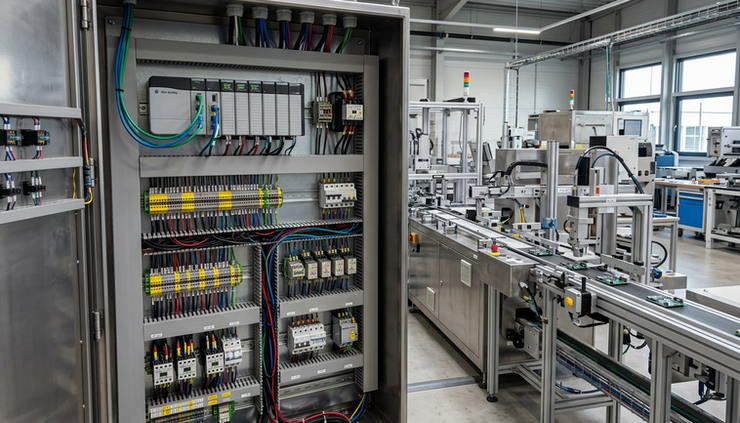
What industrial controllers do
An industrial controller receives input, makes a decision, and sends output.
That sounds simple, but the work can be demanding. A controller may need to run the same sequence thousands of times per shift, react within milliseconds, log production data, communicate with drives and instruments, and fail safely if something goes wrong.
Most control systems include four basic layers.
Field devices
These are the sensors, switches, transmitters, encoders, meters, actuators, valves, drives, motors, and safety devices connected to the equipment.
Control hardware
This is the controller itself, such as a PLC, PAC, IPC, or EPIC. It runs the control logic.
Human interface
Operators often use an HMI, panel, screen, or SCADA system to see alarms, change setpoints, and monitor the process.
Networks and data systems
Controllers often share data with other machines, plant-wide software, historians, databases, or remote monitoring systems.
The best controller for a job depends on which of these layers matters most. Some jobs need a simple, durable controller close to the machine. Others need more computing power, wider communications, or data processing at the edge of the network.
Programmable Logic Controllers are the industrial workhorse
A Programmable Logic Controller, or PLC, is the classic industrial controller. It was built for factory and plant environments where reliability matters more than fancy computing.
A PLC connects field inputs to field outputs. Inputs might come from photoelectric sensors, limit switches, temperature probes, pressure transmitters, or emergency stop circuits. Outputs might control solenoids, contactors, alarms, lamps, drives, or valve actuators.
The PLC runs a program in a repeated scan. In simple terms, it reads inputs, runs instructions, updates outputs, and repeats. This predictable pattern makes PLCs well suited to machine control, sequencing, interlocks, and discrete automation.
PLCs are common because they are:
Rugged enough for industrial sites
Clear to maintain
Well supported by technicians and electricians
Reliable over long service lives
Suitable for many machine-level tasks
A PLC can run a conveyor, batch mixer, pump station, compressor package, packaging machine, or simple process skid. It can also sit inside a larger system and exchange signals with other controllers.
The main limitation is that traditional PLCs have narrower programming and computing capability than newer controller types. Many PLCs are excellent for logic, timing, counting, interlocking, and basic analogue control. They are less suited to heavy data processing, complex file handling, advanced analytics, or high-level computing tasks.
That does not make PLCs outdated. Modern PLCs have improved greatly. Many now support Ethernet-based communications, remote I/O, better diagnostics, safety versions, motion options, and integration with HMIs and SCADA. For many applications, a PLC remains the simplest and most dependable choice.
A PLC is often the right fit when the system needs:
Fast and reliable machine control
Clear ladder logic or function block programming
Long-term maintainability
Simple fault finding
Strong electrical and environmental tolerance
Local control close to the equipment
For many plants, the PLC is still the default starting point.
Programmable Automation Controllers add power and flexibility
A Programmable Automation Controller, or PAC, builds on the PLC idea. It offers more memory, stronger processing, and broader communications. A PAC can handle control tasks while also coordinating more complex systems.
The line between PLC and PAC is not always sharp. Many modern PLCs include features once linked to PACs. Still, the difference is useful. A PAC usually suits larger or more connected applications where one controller must manage several types of equipment, networks, or data flows.
PACs are often used when a system needs to combine:
Discrete control
Process control
Motion control
Batch control
Data collection
Networked device communication
A PAC may manage several remote racks, exchange data with variable speed drives, connect with intelligent instruments, and feed information to plant software. It may also support more programming languages and more structured application design than a basic PLC.
For example, a packaging facility may use a PAC to coordinate conveyors, servo drives, barcode readers, reject systems, and production data. A utilities plant may use one to manage pumps, valves, tank levels, alarms, flow control, and reporting systems across several areas.
The practical advantage is integration. A PAC can reduce the number of separate controllers needed for complex automation. It can also support more advanced control logic and larger programs without becoming difficult to manage.

PACs are useful when multiple devices need to talk clearly and often. Their higher memory and processing capacity can help when the control system needs recipe handling, data buffering, structured alarms, or several communication protocols at once.
The trade-off is complexity. A PAC may need more careful design, stronger documentation, and more specialised support. If a job only needs simple start-stop logic and a few interlocks, a PAC may be more controller than the application needs.
A PAC is often the right fit when the system needs:
More memory than a basic PLC
Better processing for larger programs
Coordination across many devices
Stronger communication between systems
Support for mixed control tasks
Room to expand later
Industrial PCs bring computer power to control systems
An Industrial PC, or IPC, is a computer built for industrial use. It may run control software, data acquisition software, visualisation tools, machine vision, database services, or other applications that need more computing power than a PLC or PAC.
Unlike a normal consumer or office computer, an IPC is designed for harsh operating conditions. Depending on the model and installation, it may tolerate heat, moisture, dust, vibration, electrical noise, and continuous operation. Some are fanless. Some use solid-state storage. Some fit into control panels, while others mount directly on machines.
An IPC can outperform PLCs and PACs for memory, storage, graphics, and processing. That makes it valuable where control overlaps with data-heavy tasks.
Common IPC applications include:
Machine vision inspection
High-speed data logging
Advanced HMI or SCADA screens
Quality inspection systems
Motion control with complex profiles
Test benches and measurement systems
Database or file-based production records
Industrial software that needs a PC operating system
The strength of an IPC is flexibility. It can run software tools that are difficult or impossible to run on a standard PLC. For example, a quality station may use cameras, image processing, measurement algorithms, and production records. An IPC can process the images, decide pass or fail, store results, and communicate with the main controller.
The weakness is also tied to flexibility. IPCs may need more attention to operating system management, updates, cybersecurity, storage health, and application stability. A PLC is usually highly deterministic and narrow in purpose. An IPC can do much more, but that wider ability can bring more maintenance work.
This does not mean IPCs are unreliable. A properly selected and installed IPC can run well in difficult environments. The key is to use industrial-grade hardware, suitable enclosures, stable power, proper cooling, and a clear recovery plan if the software or storage fails.
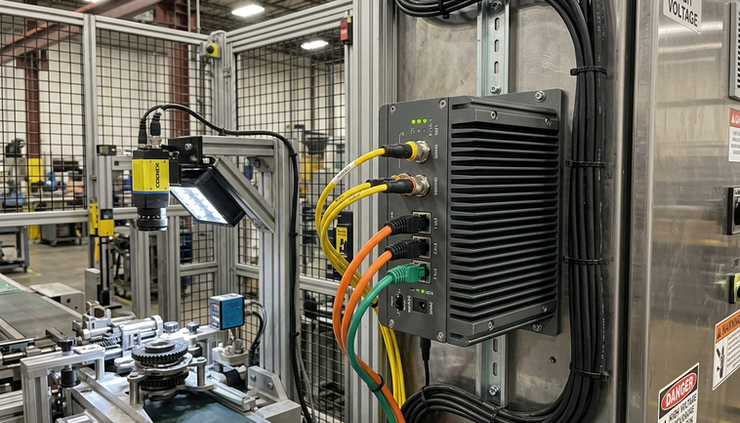
An IPC is often the right fit when the system needs:
High processing power
Large data storage
Advanced visualisation
Machine vision or image processing
Software tools based on a PC platform
Integration with databases or files
Complex calculations close to the process
In many systems, an IPC does not replace the PLC. Instead, it works beside it. The PLC handles deterministic machine control. The IPC handles computing, vision, records, or high-level coordination.
Edge Programmable Industrial Controllers process data in the field
An Edge Programmable Industrial Controller, or EPIC, is a newer type of controller built around edge computing. The main idea is simple: process useful data close to the machine instead of sending everything to a central server first.
An EPIC can collect data from field devices, run control logic, analyse information locally, and share selected data with other controllers, applications, or cloud-based systems. It sits near the equipment and makes decisions where delays are costly or where constant network access cannot be assumed.
This matters because industrial data is growing. Machines now produce readings from smart sensors, drives, meters, energy systems, vibration sensors, condition monitoring devices, and quality instruments. Sending every data point away for processing can waste bandwidth and delay response.
An EPIC can filter, calculate, store, and act locally. For example, it may monitor a pump system, detect abnormal vibration patterns, trigger a local alarm, send summary data to a maintenance platform, and keep controlling the pump even if the wider network drops out.
EPICs may suit applications where local intelligence and wider connectivity both matter. They can support remote monitoring, predictive maintenance, energy reporting, distributed assets, and real-time decisions at the equipment level.
Typical EPIC strengths include:
Data handling close to the source
Real-time response in the field
Communication with controllers and software systems
Local processing before data leaves the site
Support for distributed or remote assets
Better use of industrial network bandwidth
The EPIC concept is useful for assets spread across wide areas. Think water infrastructure, remote pump stations, energy assets, mining equipment, large production sites, or utilities. In these settings, local control is critical, but so is visibility.
A key benefit is resilience. Field equipment should not stop making basic decisions just because a cloud service, server, or network link is unavailable. Edge control keeps the most time-sensitive logic near the asset.
That said, EPICs need careful planning. Any device that connects control and data systems should be designed with cybersecurity, access control, network segmentation, and update management in mind. The broader the connectivity, the more important the security design becomes.
How these controller types compare
The easiest way to compare the four types is to look at their natural strengths.
Controller type | Best known for | Typical use |
PLC | Rugged machine and process control | Conveyors, pumps, skids, interlocks, sequencing |
PAC | More processing and communication than a basic PLC | Larger automation systems with mixed control needs |
IPC | High computing power in industrial hardware | Vision, data logging, test systems, advanced interfaces |
EPIC | Edge processing and field-based data handling | Remote assets, connected equipment, local analytics |
These are not strict boundaries. A modern PLC can communicate well. A PAC can run tough control jobs. An IPC can control equipment. An EPIC can overlap with both PLC and PAC functions. The right choice depends on the job.
A good selection process starts with the application, not the label on the hardware.
Ask practical questions:
How fast must the controller respond?
Is the task mainly discrete logic, process control, motion, data, or all of these?
How much memory and processing power does the program need?
Which devices and networks must it connect to?
Will technicians need to fault-find it at 2 am?
Does it need to run in heat, moisture, dust, or vibration?
Does it need remote access or local-only operation?
How much data should stay at the machine?
What happens if the wider network fails?
Who will maintain the system over the next decade?
The answers often point to the controller type. A simple machine may need a PLC. A more connected system may justify a PAC. A vision-heavy inspection station may need an IPC. A remote asset with local analytics may call for an EPIC.
Matching the controller to the application
For small and medium machine control, start with a PLC. It is familiar, widely supported, and built for plant-floor conditions. If the program is simple and the main goal is dependable control, a PLC is often the cleanest answer.
For larger systems with more communications and more control types, look at a PAC. It can manage a higher level of coordination without forcing the design into several separate controllers.
For applications that need serious computing, consider an IPC. It is a strong choice when the system needs image processing, large data sets, complex software, or an advanced operator interface.
For systems that need local control plus field-based data processing, assess EPIC options. They are especially useful when remote assets must make decisions locally and still share useful information with other systems.

The strongest industrial control systems usually use a mix of technologies. A plant may use PLCs for local machines, PACs for line coordination, IPCs for vision and data tasks, and EPICs for remote monitoring or edge processing. Good architecture assigns each controller the work it handles best.
The main takeaway
PLCs, PACs, IPCs, and EPICs all control industrial equipment, but they are not interchangeable in every situation.
A PLC is the dependable workhorse for local control. A PAC adds more memory, processing, and communication for larger systems. An IPC brings industrial computing power to control, data, vision, and software-heavy tasks. An EPIC adds edge processing so equipment can respond to data in the field and share the right information with wider systems.
The best choice is the one that fits the process, the environment, the data needs, and the people who will maintain it. Start with the control problem, then choose the hardware that solves it with the least unnecessary complexity.


