.png)
PLC Controlled Batching for Repeatable Liquid Transfer Recipes
Manual filling often looks simple until the same batch has to be made again. One operator stops a valve a little early. Another waits until the tank mark is reached. A pump takes longer on a hot day. A drum is swapped, a hose is moved, and the next order does not quite match the last one.
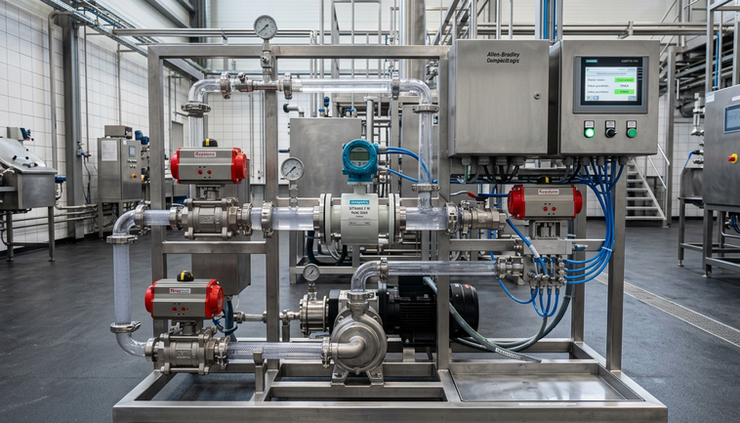
For water transfer, mixing, dilution, chemical dosing, and many other liquid-handling tasks, small differences can add up. A PLC-controlled batching system brings the moving parts together: a flow meter measures what has passed, valves start and stop the flow, and the operator selects a stored recipe rather than relying on memory or handwritten notes.
That does not mean every application needs a complex automation project. Many batching jobs need a clear sequence, a reliable measurement signal, safe start conditions, and a sensible way to record what happened. ProSense Solutions approaches these systems from that practical angle, matching the controls to the liquid, the process, and the level of repeatability required.
Why manual batching becomes hard to repeat
Manual batching relies on observation and timing. That can work for low-risk transfers, but it becomes less reliable when the same result must be produced on different shifts or weeks apart.
Common issues include:
Operators using different visual fill marks or timing methods
Valves taking time to close after the stop command
Flow rates changing as pump performance, head pressure, filters, or tank levels change
Recipes being adjusted informally and not recorded
Start conditions being missed, such as the wrong valve position or insufficient source level
Finished batch quantities being written down after the fact, if at all
A PLC does not remove the need for good process design. It gives the process a repeatable structure. Once the recipe is selected, the controller can check the required conditions, open the correct valves, count flow-meter pulses or read an analogue flow signal, stop at the target, and store the result.
The goal is not automation for its own sake. The goal is to make the next batch behave like the last one.
The core parts of a PLC batching system
Most liquid batching systems use the same basic building blocks, even when the equipment layout changes.
Component | What it does | Practical detail |
PLC | Runs the sequence and stores the logic | Handles batch steps, alarms, permissives and data |
Flow meter | Measures the liquid transferred | Must suit the liquid, pipe size, conductivity, viscosity and flow range |
Valves | Start, stop or direct flow | Actuated valves need known response times |
Pump | Provides flow where gravity is not enough | Pump control can be fixed speed or variable speed |
Operator interface | Lets the operator choose a recipe and start a batch | Usually an HMI, push-button station or simple panel |
Sensors | Confirm safe conditions | Level switches, pressure switches, valve feedback and tank status signals are common |
Records | Capture batch results | Useful for repeat orders, troubleshooting and quality checks |
For a simple water transfer, the PLC may only need a start button, a target volume, a flow meter input, and one valve output. For a multi-ingredient mixing process, the same idea can expand into several ingredients, flush steps, agitation, tank level checks, and recipe permissions.
The useful question is not, “How much automation can be added?” It is, “What information does the PLC need to make the transfer repeatable and safe?”
How flow measurement becomes a batch total
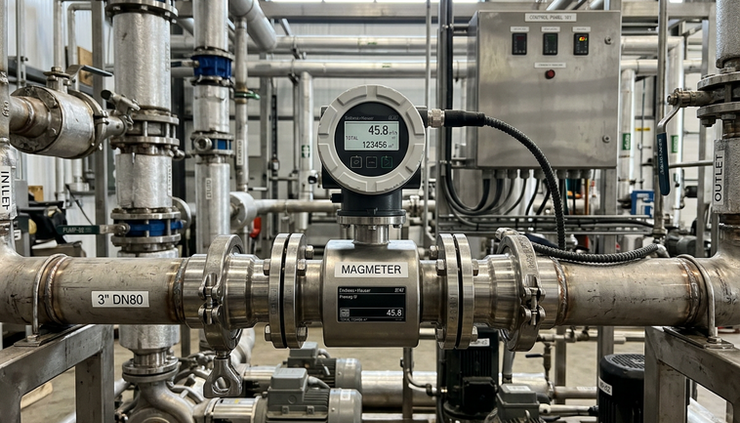
The flow meter is the measuring point in the batching system. It tells the PLC how much liquid has passed through the line.
There are two common ways this information reaches the controller.
Pulse signals count a known amount per pulse
Many flow meters provide a pulse output. Each pulse represents a set amount of liquid, such as a fraction of a litre or a certain number of litres. The PLC counts these pulses and converts them into a batch total.
This method is common because it is direct and easy to check. If the meter produces one pulse per litre, the controller counts 500 pulses for a 500 L batch. In real systems, the pulse scaling may be more detailed, but the principle is the same.
The PLC program needs to handle the signal cleanly. Fast pulses may require a high-speed counter input. Noisy wiring, poor shielding, or incorrect input settings can cause missed counts or false counts, so installation matters.
Analogue signals report a live flow rate
Some meters provide a 4 to 20 mA signal that represents live flow rate. The PLC reads the flow rate and calculates the total over time. This can work well, especially when live rate display and alarms are useful.
The trade-off is that totalising from an analogue rate depends on scan time, scaling and signal quality. For precise batching, the design must treat the analogue input carefully and test it against known volumes.
For many batching applications, a dedicated pulse total is preferred for quantity, while analogue flow can still be useful for display, diagnostics or low-flow detection.
Recipes turn setpoints into repeatable instructions
A recipe is more than a batch size. It is a stored set of instructions that tells the PLC what to make and how to make it.
A simple recipe might include:
Target volume
Product name or batch code
Source tank selection
Destination tank selection
Maximum allowed fill time
Agitator run time
Pre-fill or post-fill flush step
Operator prompts
Tolerance limits
For water transfer, the recipe may be as simple as `Recipe 1 = 1,000 L to Tank A` and `Recipe 2 = 2,500 L to Tank B`. For mixing, a recipe might call for water first, then concentrate, then a timed mixing step.
Recipes reduce operator variation because the values are selected rather than re-entered each time. They also protect the process from accidental changes. A well-designed HMI can let operators choose approved recipes while limiting recipe editing to authorised users.
This is especially useful for repeat orders. If a customer, production run or internal process requires the same transfer again, the operator can select the same stored recipe and run the same sequence. The PLC can then record what was actually delivered, which helps confirm the repeat run.
Valve control is where timing becomes real
A batch does not stop the instant the PLC sends a close command. Valves need time to move. Liquid may keep moving through the line. Pumps may coast. Pipework may drain. These effects are small in some applications and large in others.
That is why batching logic often includes a stopping delay or pre-act value.
If a system needs a 1,000 L batch and typically delivers another 8 L after the outlet valve is told to close, the PLC can stop active filling at 992 L. The remaining movement brings the final total closer to target.
This value should not be guessed once and forgotten. It can change with:
Flow rate
Valve type and size
Pump speed
Pipe length after the valve
Liquid viscosity
Pressure changes
Whether the line stays full or drains
Some systems use a fixed pre-act amount. Others adjust it based on previous batches. A basic system might let a technician tune the value during commissioning. A more advanced system may calculate correction based on recent overfill or underfill results.
Valve feedback can also matter. If the PLC commands a valve open but does not receive an open confirmation, it can stop the sequence and raise an alarm. The same applies when a valve fails to close. This protects both the batch and the equipment.

Permissive conditions help prevent the wrong batch
A permissive is a condition that must be true before the PLC allows a step to run. It is one of the simplest ways to make a batching system safer and more consistent.
For example, the PLC may check that:
The destination tank is selected and ready
The source tank has enough liquid
The correct valve path is available
No emergency stop is active
The pump is healthy
The flow meter signal is present
A drain valve is closed
A high-level switch is not active
The operator has acknowledged the recipe details
These checks reduce avoidable mistakes. They also make faults easier to understand. Instead of a silent failed transfer, the HMI might display `Source tank low` or `Outlet valve failed to open`.
Permissives are not a replacement for mechanical design or risk assessment. They support the process by making the sequence follow known rules. In liquid transfer, where a wrong valve path can fill the wrong tank or contaminate a batch, that control can be critical.
A typical PLC batch sequence
Each site has its own details, but a repeatable liquid transfer sequence often follows a pattern.
Select the recipe
The operator chooses the required recipe from the HMI. The PLC loads the target volume, valve path, mixing time and any other stored values.
Check the permissives
The PLC confirms that the source, destination, valves, pump and safety conditions are ready. If a condition is missing, the sequence does not start.
Prepare the line
The controller may close drain valves, open the destination route, reset the batch total and confirm that the flow meter is reading zero flow before transfer begins.
Start filling
The PLC opens the fill valve and starts the pump if required. It begins counting pulses or totalising the flow signal.
Monitor the fill
The controller compares the live total against the target. It may also monitor flow rate, timeout limits, pressure and tank level.
Stop before the target if needed
If the system has a known stopping delay, the PLC closes the valve or stops the pump before the exact target, allowing the remaining liquid movement to finish the batch.
Confirm completion
The system waits for flow to stop, checks the final total and compares it with tolerance limits.
Run any post-fill steps
The process may start an agitator, flush a line, close valves, or prompt the operator to move a hose.
Record the result
The PLC or HMI records recipe name, target, actual total, date, time, operator ID if used, and any alarms.
This structure keeps the process clear. It also makes troubleshooting easier because each step has a defined purpose.
Recording results supports quality and troubleshooting
Batch records do not need to be complicated to be useful. Even a modest record can help answer practical questions later.
A useful record may include:
Recipe selected
Batch target
Final measured volume
Start and finish time
Source and destination
Whether the batch finished within tolerance
Alarms or interruptions
Operator acknowledgement where relevant
For repeat orders, these records provide evidence that the same recipe was run and show whether the delivered quantity matched the target. For maintenance, they can show patterns such as increasing fill time, unstable flow, or regular overrun.
The recording method can be simple or detailed. Some systems store recent batches on an HMI. Others send data to a supervisory system or export files for production records. The right level depends on the process, audit needs and site standards.
A good rule is to record the information that someone will actually use. Too little data leaves gaps. Too much data becomes noise.

Practical considerations for water transfer and mixing
Water is often the easiest liquid to handle, but the system still needs proper design. Flow meters need straight pipe lengths where required by the manufacturer. Pumps need suitable duty points. Valves should suit the pressure, flow and cycle rate. Pipework should avoid trapped air where it affects readings.
In water transfer applications, the biggest gains often come from consistent targets, clear valve control and reliable totalising. Examples include:
Filling process tanks
Transferring treated water
Preparing dilution volumes
Feeding mixing vessels
Loading or unloading intermediate tanks
Mixing applications add another layer. The batch may need ingredients added in order, a minimum mix time, or an interlock that prevents discharge until mixing is complete. The PLC can manage these steps, but the physical process must still support good mixing. Tank geometry, agitator type, fill point location and liquid properties all affect the end result.
Suitable liquid applications can include water-like fluids, compatible chemical solutions, food or beverage ingredients where equipment is hygienic and compliant, and other pumped liquids that can be measured accurately. The flow meter, seals, valve materials and pipework must match the liquid. Aggressive chemicals, viscous products, foaming liquids or fluids with suspended solids may need different measurement and valve choices.
ProSense Solutions can help define these limits early, so the batching design fits the real liquid rather than an ideal version of it.
What makes a batching project work well
The best batching systems usually come from clear scope and good commissioning. The controls cannot fix every mechanical issue, but they can make a sound process repeatable.
Key decisions include:
How accurate the batch needs to be
Which signal will provide the batch total
Whether pump speed must be controlled
How valve overrun will be handled
Which permissives are essential
Who can edit recipes
What batch data needs to be stored
How operators will recover from alarms
What happens after power loss or an interrupted batch
Commissioning should include real liquid tests where possible. Dry testing proves the sequence logic, but wet testing proves the measurement, valve timing and stopping behaviour. The final system should be checked across the normal flow range, not only at one ideal condition.
Operator training also matters. A clear HMI, useful alarm messages and agreed procedures help the system deliver consistent results shift after shift.
Repeatable batching comes from measured control
A PLC batching system brings structure to liquid transfer. The flow meter provides the measured quantity. The valves and pumps control movement. The recipe gives the operator a repeatable starting point. The PLC ties these parts together with permissives, stopping logic and records.
For manual processes that are hard to repeat, this can make a major practical difference. Batches become easier to reproduce, faults become easier to trace, and repeat orders no longer depend on who happened to run the transfer last time.
Start with the process, the liquid and the target result. From there, the right PLC-controlled batching design can be built to match the job, whether it is a simple water transfer or a more controlled mixing sequence.


