.png)
Monitoring Remote Tanks in Australian Summer for Reliable Water Storage
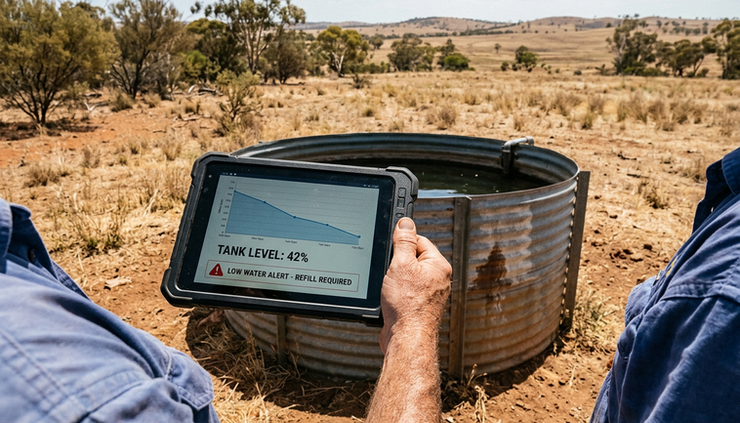
A remote tank can look fine on Monday and become a problem by Friday. In Australian summer, heat, wind, peak water use, pump faults, stock demand, irrigation cycles and long refill delays can all arrive at once. By the time someone drives out to check the gauge, the window to act may already be closing.
Reliable water storage depends on more than knowing whether a tank is “full” or “low”. It depends on seeing how the level changes, how refills behave, whether drawdown looks normal, and whether the sensor itself can be trusted in harsh outdoor conditions.
Good monitoring turns a tank from a static asset into a live water balance. It shows how much usable water remains, how quickly it is being used, and how long replenishment will take under real summer conditions.

Summer changes the risk profile of remote tanks
Australian summer is hard on water storage systems. Demand often rises at the same time as replenishment becomes less predictable. Hot weather can increase domestic and operational water use. Stock drink more. Irrigation schedules may run longer. Dust and storms can affect equipment. Solar power performance can vary with panel condition, shade, smoke or heat stress. Access tracks may also become difficult during fire danger periods or after summer storms.
For a town supply, farm system, mine site, caravan park, remote facility or environmental water point, that mix creates a simple problem: every litre matters more when travel time is long and demand is high.
A basic tank reading can still help, but it rarely tells the full story. A tank at 45 per cent may be safe if it refills every night and demand is stable. The same tank at 60 per cent may be at risk if drawdown is steep, refills are failing, and the next service visit is two days away.
That is why remote tank monitoring should answer four practical questions:
How fast is the tank level falling?
Is the refill system behaving as expected?
Is any drawdown abnormal for this site and season?
Is the sensor giving trustworthy data?
Those questions move monitoring away from a single low-level alarm and towards operational decisions.
Level trends matter more than single readings
A single level reading is a snapshot. A trend is a story.
During summer, the shape of the tank level curve can reveal whether the system is healthy. A steady daily pattern may show normal use. A sharp fall during peak heat may point to higher demand. A sudden drop outside known use periods may suggest a leak, stuck valve, open hydrant, burst line, unauthorised use or failed control.
A useful trend view should show:
Current usable volume
Rate of fall over recent hours
Daily and weekly usage pattern
Minimum level reached during each demand cycle
Time since last successful refill
Expected time to reach the operating reserve
The key word is usable. A tank may physically contain water below an outlet level, but that volume may not be available to the system. Sediment allowance, dead storage, pump suction height, outlet position and operational reserve all reduce what can be used.
Percentage thresholds hide this detail. A 20,000 litre tank at 25 per cent and a 250,000 litre tank at 25 per cent sit in very different risk positions. Even within the same tank, 25 per cent may mean different things if the usable storage starts above the tank floor.
A better alert uses actual volume and time. For example:
Alert basis | What it tells you | Why it helps in summer |
Generic percentage | The tank has crossed a set level | Simple, but may not reflect usable water |
Usable storage | How much accessible water remains | Matches the real operating limit |
Drawdown rate | How quickly water is being consumed | Shows whether demand has changed |
Time to reserve | How long before the tank reaches the minimum safe level | Supports earlier decisions |
Replenishment time | Whether refill can recover the tank before demand peaks | Links supply and use together |
A tank is safe when it can meet demand until the next reliable refill. Monitoring should reflect that.

Refill behaviour shows whether the system can recover
Many water storage systems fail gradually before they fail completely. A pump still runs, but flow is reduced. A bore takes longer to recover. A strainer blocks. A float valve sticks. A solar-powered pump starts later than usual or stops earlier than expected. The tank still refills, but not enough.
Refill behaviour is one of the best early warning signals.
Healthy refill data should show when replenishment starts, how long it runs, and how much volume it adds. Over time, this builds a normal pattern for each site. During summer, that pattern becomes the reference point for detecting trouble.
Common warning signs include:
Refills start later than expected
Refill rate drops over several cycles
The tank no longer reaches its normal high level
Refill stops before the expected recovery point
The same pump run time delivers less water
The tank falls again soon after refill
These signs matter because summer demand can mask supply problems. If a site uses more water during hot weather, a weak refill source may not catch up. The tank level may look acceptable in the morning and still run into trouble in the afternoon.
A better alert might be based on a question such as:
Will the tank recover above the operating reserve before the next peak demand period?
That is more useful than “alert at 30 per cent”. It connects the alarm to the real risk.
For example, a remote site may have a summer demand peak from late afternoon into early evening. If the tank is dropping quickly at midday and the refill system usually needs six hours to recover the usable volume, the alert should come early enough for someone to act. Waiting for a low percentage may be too late.
Abnormal drawdown deserves its own alerts
Drawdown is the fall in tank level as water leaves the system. Some drawdown is expected. The value comes from knowing what is normal for that tank.
A cattle trough supply may have predictable drawdown that rises during hot days. A remote accommodation site may show morning and evening peaks. A fire service header tank may sit nearly static for long periods. Irrigation storage may fall in planned blocks.
Abnormal drawdown is different. It means the tank is losing water faster than the known pattern suggests.
Possible causes include:
A leak in a long pipe run
A failed valve or float
Unplanned water use
A pump running against the wrong duty
A damaged fitting after maintenance
Theft or open access point
A sensor reading affected by foam, turbulence or obstruction
To detect abnormal drawdown, monitoring needs context. The system should not treat every fast level fall as a fault. A planned irrigation cycle may look like a leak unless it is tied to the operating schedule. At the same time, a slow leak may not trigger a simple low-level alarm until large volumes are lost.
This is where trend-based rules help. A site can use alerts such as:
Level falling faster than the normal daytime rate
Level falling during a period when no demand is expected
Net loss continuing after outlet valves should be closed
Refill and drawdown happening at the same time, with no net recovery
Daily usage exceeding the usual summer range for that site
The best alarm is not always the loudest one. It is the one that gives enough time to check the cause before storage becomes critical.

Sensor health is part of water security
A tank alarm is only useful if the sensor and power system are healthy. In remote locations, sensor health should be monitored as carefully as water level.
Outdoor equipment has to cope with heat, direct sun, UV exposure, rain, dust, insects, vibration, condensation and long periods without attention. In some areas, lightning and electrical noise also need attention. If the monitoring device runs on batteries or solar power, energy management becomes part of the design.
Sensor health checks can include:
Battery voltage or state of charge
Solar charging performance
Signal strength or communications uptime
Last successful data transmission
Sensor error state
Reading stability
Sudden impossible changes in level
Long periods with no change where change is expected
A flat line is not always good news. It may mean a stable tank, or it may mean a stuck sensor, failed communications, blocked acoustic path, damaged cable or power fault. The monitoring system should distinguish between “level unchanged” and “data not reliable”.
Different level technologies also suit different tank conditions. A vented pressure sensor may be suitable in some installations, while ultrasonic or radar measurement may be better where non-contact sensing is preferred. The right choice depends on tank shape, mounting position, liquid surface behaviour, access, expected sediment, cable routes, power availability and maintenance conditions.
This is where ProSense can help. Rather than choosing a device only by measurement range, ProSense can support selection around the site conditions that matter most:
Outdoor exposure and enclosure rating
Temperature range and UV exposure
Tank material and mounting options
Power source, including solar and battery operation
Communications options for remote locations
Cable protection and surge considerations
Sensor type for the liquid surface and tank geometry
Maintenance access and expected service intervals
A system that survives the summer but drains its battery every time it transmits too often is not a reliable system. A sensor that reads well in a workshop but struggles with a hot, dusty tank roof is not the right fit. Equipment selection should match the place where the data is needed.
Alerts should reflect usable storage and response time
The simplest tank alert is a fixed percentage. It is easy to understand, but it often creates poor decisions. Some alarms come too late. Others create nuisance alerts. Both outcomes reduce trust.
A better alert design starts with the operating question: How long can this site continue safely if no refill happens now?
That question brings together tank level, usable volume, drawdown rate, refill rate and response time.
For remote tanks, alert configuration should consider:
Minimum usable reserve
Average and peak summer demand
Fastest expected drawdown
Time required for staff or contractors to attend
Time required for cartage, pump repair or manual refill
Normal replenishment rate
Communications delay or outage risk
Consequence of running dry
For example, a low-priority rainwater tank near a staffed site may only need a low usable-volume alert. A remote livestock or critical process water tank may need staged alarms based on time remaining.
A practical alarm set might include:
Early watch
Usable storage is falling faster than normal, but still above the operating target.
Refill concern
Replenishment has not started, has stopped early, or is adding less volume than expected.
Response required
Storage is projected to reach reserve before the next normal refill or before a crew can attend.
Critical reserve
Usable volume is near the minimum safe level and immediate action is needed.
This approach reduces false confidence. A tank at 50 per cent can still trigger a response alert if the drawdown rate shows it will hit reserve before help can arrive. A tank at 25 per cent can remain in watch mode if refill is running well and recovery is likely before demand rises.
That is the real value of Monitoring Remote Tanks in Australian Summer for Reliable Water Storage. It makes the alert match the operational risk, not just the tank geometry.
Build the monitoring plan around the whole water balance
Reliable tank monitoring is not only a sensor project. It is a water balance project.
Start with the tank’s usable storage. Confirm outlet height, dead storage, safe reserve and any operational limits. Then map demand. Identify normal daily use, summer peaks, planned high-use events, and periods when no use should occur.
Next, map replenishment. Record the expected refill source, pump run time, refill rate, control method and any dependencies such as solar power or generator availability. If water cartage is part of the backup plan, include travel time and refill time.
From there, alerts can be set around the site’s real limits. The aim is to avoid both dry tanks and alarm fatigue.
A good monitoring plan defines:
What level data is needed
How often readings should be taken
How often data should be transmitted
What counts as abnormal drawdown
What counts as failed or weak refill
What sensor health data should be reported
Who receives each alert
What action each alert requires
This last point matters. Every alert should have a response. If an alarm does not lead to a decision, adjustment or site check, it may need to be changed.
What reliable summer monitoring looks like
A well-designed remote tank monitoring system gives operators enough warning to protect water supply before the tank reaches a crisis point.
It should show the current level, but it should also show direction, speed and recovery. It should detect whether the refill system is keeping up. It should flag abnormal losses before they become major failures. It should report sensor and power health, so the data remains trusted.
ProSense can support this by helping match sensors, power arrangements and communications hardware to Australian outdoor conditions and remote-site needs. The best result comes when equipment selection and alert setup happen together. The sensor must survive the site, and the alarms must reflect how water is actually stored, used and replaced.
A remote tank is reliable when it can meet demand until replenishment arrives. Summer monitoring should be built around that standard. Not a generic percentage. Not a guess from the last site visit. A clear view of usable water, drawdown, refill behaviour and time to act.


