.png)
Choosing the Right Wireless Monitoring Network: Monnit, LoRaWAN, NB-IoT or 4G
A wireless sensor project can fail for a surprisingly simple reason: the sensor was fine, but the network was wrong.
Industrial monitoring is no longer limited to hardwired systems and manual inspections. Facilities, farms, utilities and remote asset operators can now track temperature, tank levels, pump status, water movement, soil moisture, door openings, equipment runtime and many other signals without running cable to every point.
The hard part is choosing the right wireless path.
Monnit, LoRaWAN, NB-IoT and 4G can all support useful monitoring systems, but they suit different sites. A factory shed with mains power and a handful of sensors has different needs from a broadacre farm, a remote tank, a pump station or a refrigerated store. ProSense looks at the whole site before recommending a system, including range, existing infrastructure, power availability, reporting frequency and ongoing costs.

Start with the job the monitoring system must do
Before comparing network types, it helps to define the monitoring task in plain terms.
A good wireless monitoring design answers these questions:
What needs to be measured?
How far is each sensor from the gateway or mobile network?
Is there mains power, battery power or solar power?
How often does the data need to be reported?
Does the site already have internet, Wi-Fi, Ethernet or cellular coverage?
How many sensors will be added later?
What happens if a reading is missed?
Who needs alarms, reports or dashboard access?
These answers matter more than brand preference. A freezer temperature alarm might need frequent reporting and fast alerts. A soil moisture sensor in a paddock may only need to report a few times a day. A remote diesel tank may sit kilometres from the nearest building, but still need reliable level readings.
That is why ProSense does not treat wireless monitoring as a one-size-fits-all decision. The right choice depends on the site conditions and the business risk attached to the data.
Monnit suits straightforward sensor deployment
Monnit is often a strong fit for facilities that need a practical, packaged sensor system without building a large network from scratch.
It works well where there are defined assets, moderate range requirements and a clear path back to a gateway. Typical uses include cold rooms, warehouses, plant rooms, equipment rooms, indoor production spaces and storage areas.
The appeal is simple: Monnit makes sensor deployment relatively straightforward. Sensors, gateways and cloud reporting are designed to work together. That can reduce setup time and make it easier to roll out monitoring across a facility.
Common Monnit monitoring applications include:
Temperature and humidity monitoring
Water leak detection
Door and access monitoring
Equipment runtime tracking
Dry contact status monitoring
Light, motion or occupancy sensing
Freezer, fridge and cold chain alerts
For many businesses, that is enough. They do not need to design a private wide-area network. They need a dependable way to get sensor data into alerts and reports.
Monnit is best suited when:
Sensors are within a realistic range of one or more gateways
The site has internet available at the gateway point
The sensor count is modest to medium
The priority is quick deployment
The application needs simple alarms and trend data
Its limits appear when the site becomes very large, highly distributed or remote. A farm with sensors spread across paddocks may need greater range than a typical facility network can provide. A tank in an isolated location may not have a nearby gateway or internet connection. In those cases, LoRaWAN, NB-IoT or 4G may be a better match.
LoRaWAN supports long-range multi-device networks
LoRaWAN is well suited to sites that need long-range wireless coverage across many low-power devices. It is commonly used in agriculture, utilities, environmental monitoring, councils, water networks and large industrial sites.
The key benefit is range. LoRaWAN devices can send small packets of data over long distances to a gateway, especially where the gateway has good height and line of sight. It is designed for low-power sensor data rather than high-bandwidth traffic.
That makes it a strong option for monitoring points such as:
Soil moisture probes
Rain gauges
Weather stations
Tank level sensors
Flow meters
Gate or fence status sensors
Pump status points
Environmental sensors
Remote shed and paddock monitoring
LoRaWAN can be deployed as a private network, where the site owner runs their own gateways, or through a public or shared network where coverage exists. On larger properties, one well-placed gateway can support many sensors. More gateways can be added to improve coverage or overcome terrain.

Monitoring Australian farms with Dragino LoRaWAN technology
Australian farms are a natural fit for LoRaWAN when the monitoring points are spread out and the data packets are small. Dragino LoRaWAN devices are commonly used in these types of low-power, long-range sensing projects because they support practical field monitoring across agriculture and environmental applications.
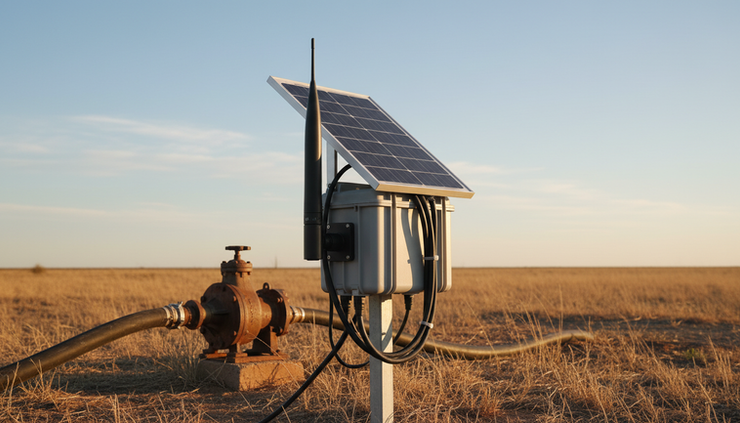
A farm may need to monitor tank levels near a bore, soil moisture across different paddocks, rainfall, pump operation and shed conditions. Running cable is usually impractical. Mobile coverage may be patchy. Batteries and solar power matter because sensors can sit far from mains power.
A Dragino LoRaWAN setup can help connect these points back to one or more gateways, then into a dashboard or alerting system. The network design still needs care. Gateway placement, terrain, vegetation, antenna height and distance all affect performance. A sensor that works from one paddock may not work from another if a ridge, shed or dense tree line blocks the signal path.
ProSense assesses those details before recommending LoRaWAN. The goal is not just to make one sensor connect during testing. The goal is to build a system that keeps reporting through seasonal changes, farm activity and practical field conditions.
NB-IoT connects low-power assets directly
NB-IoT, short for Narrowband Internet of Things, uses cellular network infrastructure to connect devices that send small amounts of data. It is designed for low-power, low-data applications.
Its main advantage is direct connection. A sensor can report through the mobile network without a local gateway, as long as there is suitable NB-IoT coverage. That makes it useful for isolated assets where installing and maintaining a gateway would add too much cost or complexity.
NB-IoT can suit:
Remote water meters
Tank level sensors
Environmental monitoring stations
Asset status sensors
Low-frequency equipment monitoring
Sites without local internet
The trade-off is coverage and carrier availability. NB-IoT is not the same as standard mobile voice or data coverage. A site may have mobile reception on a phone but still need confirmation that the device and carrier service will support the required NB-IoT connection at that location.
NB-IoT is also better for small, occasional messages than frequent reporting or large data payloads. If an asset only needs to report a few times per day, it may be a good fit. If the system needs near real-time readings, camera data or frequent alarm checks, 4G may be more suitable.
4G is useful for isolated assets that need more data
4G monitoring also uses cellular networks, but it supports higher data rates than NB-IoT. It is a practical option when an asset is isolated and needs to connect directly to the internet.
A 4G device can suit remote pump stations, temporary worksites, transportable equipment, process skids, mine site assets, generators, telecommunications shelters and other standalone systems.
4G brings more flexibility. It can support:
More frequent reporting
Larger data payloads
Remote access to controllers or data loggers
Multiple connected sensors behind one router
Alarm notifications from isolated sites
Temporary monitoring installations
The trade-off is power use and running cost. A 4G router or modem generally needs more energy than a low-power LoRaWAN or NB-IoT sensor. That may be fine where mains power exists. In solar and battery installations, power budgeting becomes a key design step.
SIM costs also matter. One 4G connection may be economical for a remote site with many connected points. It may be too costly if every small sensor needs its own SIM and data plan.
How the main options compare
The best network is the one that fits the physical site and the reporting need. This table gives a practical comparison.
Network option | Best fit | Main strengths | Watch points |
Monnit | Facilities, storage areas, plant rooms and defined indoor or nearby assets | Fast deployment, packaged sensors and gateways, simple alerts | Range and gateway location need checking |
LoRaWAN | Farms, utilities, large sites and many spread-out low-power sensors | Long range, low power, supports many devices | Gateway placement and terrain are critical |
NB-IoT | Isolated low-data assets with suitable cellular IoT coverage | Direct-to-network connection, low power, no local gateway | Coverage must be confirmed, limited data rate |
4G | Remote assets needing more data or direct internet access | Flexible, higher data capacity, useful for remote routers | Higher power use and ongoing SIM costs |
No single option wins every time.
A manufacturing site may use Monnit for cold room alarms and door sensors. The same business may use 4G for a remote wastewater pump station. A farm may use Dragino LoRaWAN devices across paddocks, plus a 4G backhaul connection at the gateway if there is no wired internet nearby.
That mixed approach is common. The network can be chosen area by area, rather than forcing every sensor into one technology.
How ProSense evaluates a site before recommending a system
A reliable monitoring system starts with a site review. ProSense looks beyond the sensor model and checks the conditions that decide whether the system will work in daily use.
Range and physical layout
Distance matters, but it is not the only factor. Buildings, tanks, cool rooms, hills, trees, machinery, metal cladding and ground level all affect radio performance.
For indoor sites, ProSense looks at walls, cool room panels, plant room locations and gateway positions. For outdoor sites, the review includes terrain, antenna height, line of sight and the spread of monitoring points.
LoRaWAN may suit wide areas, but gateway placement can make or break the result. Monnit may suit a facility, but extra gateways may be needed if sensors sit behind heavy walls or in separate buildings.
Existing site infrastructure
Some sites already have Ethernet, Wi-Fi, power and secure cabinet locations. Others have none of these.
A facility with reliable internet can often support gateway-based monitoring. A paddock, tank or roadside asset may need cellular backhaul or a direct NB-IoT or 4G device.
ProSense checks what is already available before adding new hardware. Using existing infrastructure can reduce cost, but only if it is reliable enough for monitoring.
Power availability
Power is one of the biggest differences between network choices.
Battery-powered sensors suit low-frequency reporting and small data messages. Solar can help remote sites, but the load must be calculated carefully. Mains power gives more freedom for gateways, routers and frequent communications.
A poor power design leads to flat batteries, missed data and extra site visits. ProSense matches reporting frequency and network type to the available power source.
Reporting frequency and alarm needs
Some readings only need to arrive once or twice per day. Others need fast alerts.
A tank level on a farm may not need minute-by-minute data. A freezer alarm or pump fault may need a much shorter reporting interval. More frequent reporting usually means higher power use and, in cellular systems, potentially higher data use.
The reporting plan should match the real operational risk. Too little data can miss issues. Too much data can drive up cost without improving decisions.
Ongoing costs
The hardware price is only part of the system cost.
Long-term costs can include:
SIM plans
Cloud platform fees
Gateway maintenance
Battery changes
Site visits
Data storage or dashboard access
Additional gateways or antennas
Support and configuration changes
A low-cost device can become expensive if it needs frequent attention. A higher upfront cost may be worthwhile if it reduces site visits or supports more sensors over time.

Match the network to the real conditions
The right monitoring network is rarely chosen from a brochure. It comes from the site.
Monnit is a strong choice where a facility needs straightforward sensor deployment and practical alerts without major network design. LoRaWAN is well suited to long-range monitoring across many low-power devices, especially on farms and large industrial sites. NB-IoT and 4G can connect isolated assets directly when gateway-based networks are not practical.
A good system also allows for growth. New tanks, extra rooms, added pumps or more paddock sensors should not force a full rebuild. That is why ProSense looks at the current need and the likely next stage before recommending Monnit, LoRaWAN, NB-IoT or 4G.
Wireless monitoring works best when the network fits the asset, the site and the reporting task. Choose that way and the system becomes easier to install, easier to maintain and far more useful over time.


