.png)
ACREL Energy Monitoring at Darwin Port Australia
Ports run on electrical systems that cannot afford guesswork. Cranes, pumps, workshops, lighting, shore-side services, switchboards and support equipment all draw power across wide sites, often with limited access and long cable runs. When energy data sits inside local meters only, faults are harder to trace, load changes are harder to understand, and site teams lose time walking from board to board.
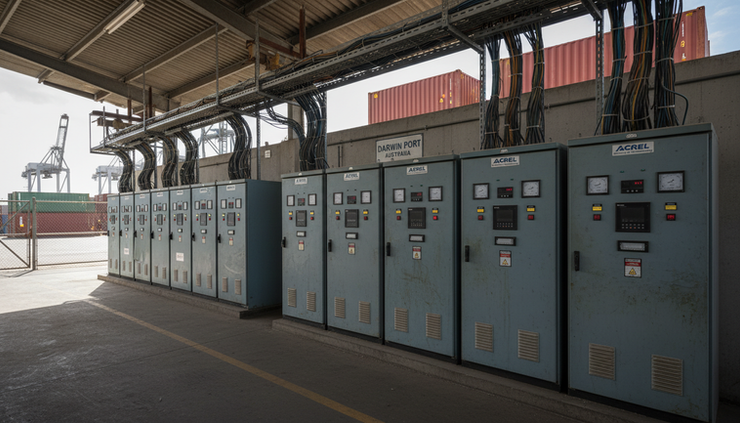
The ACREL energy monitoring project at Darwin Port shows a practical way to solve that problem in an Australian industrial setting. The installation uses ACREL ADW310-4GHW and ADW300-4GHW wireless energy meters, paired with AKH split-core current transformers and the ACREL IoT Energy Management System.
The result is remote electrical energy monitoring with central access to energy data, without the need for major changes to existing electrical infrastructure. It is a strong example of how field-level metering, 4G communications and cloud-based energy management can work together across a demanding site.
Why port energy monitoring needs a different approach
Port sites are different from single-building facilities. Electrical loads are often spread across many boards and operating areas. Some assets are in controlled plant rooms, while others sit closer to outdoor or semi-outdoor industrial zones. Access may be affected by operational schedules, safety requirements, weather and the movement of vehicles or cargo.
A conventional energy monitoring upgrade can become difficult if it needs large amounts of rewiring, shutdown time or new communications cabling. Many industrial sites already have working switchboards and established electrical layouts. The challenge is to improve visibility without creating unnecessary disruption.
That is where wireless and cellular metering can be useful. A metering device installed at the switchboard can collect electrical data at the point of use. A 4G connection can then send that data to a central platform. Site managers, electricians and energy teams can review the information remotely, instead of relying only on manual meter checks.
For Darwin Port, this approach fits the nature of the site. The port environment calls for energy monitoring that can support distributed assets, remote access and practical installation within existing infrastructure.
The equipment used at Darwin Port
The project combines several parts of the ACREL energy monitoring system. Each part has a clear role.
Component | Role in the system |
ACREL ADW310-4GHW wireless energy meter | Measures electrical energy data and communicates over 4G |
ACREL ADW300-4GHW wireless energy meter | Supports remote metering applications across distributed circuits |
AKH split-core current transformers | Measure current without requiring full conductor disconnection in many retrofit situations |
ACREL IoT Energy Management System | Provides centralised access to metering data through a cloud-based platform |
The ADW310-4GHW and ADW300-4GHW meters are built for applications where wired data networks may be difficult or costly to install. With 4G communications, the meters can send readings back to the energy management platform from different locations across a site.
The AKH split-core current transformers also matter in a retrofit setting. Split-core CTs can often be installed around existing conductors, reducing the need for major switchboard changes. Electrical installation still needs to be completed safely by qualified personnel, but the split-core design helps avoid unnecessary rework where the existing electrical infrastructure is suitable.
Together, the meters and CTs create a field-level measurement layer. The IoT platform then turns those measurements into usable information.

How the monitoring architecture works
At a high level, the Darwin Port system follows a simple path.
Power flows through the monitored circuits. AKH split-core CTs measure the current. The ACREL ADW310-4GHW and ADW300-4GHW meters collect the electrical data. The meters use 4G communication to send data to the ACREL IoT Energy Management System. Users can then access the information through a central platform.
This architecture avoids a common problem in industrial metering projects: collecting data in the field but leaving it trapped at the switchboard. A meter display is useful during inspection, but it has limited value if someone must be physically present to read it.
Central access changes the workflow. Energy data can be reviewed from a single system, which can help with:
Checking energy use across different boards or areas
Comparing loads over time
Spotting unusual consumption patterns
Supporting maintenance investigations
Reducing reliance on manual meter readings
Building a clearer picture of site electrical demand
For a large facility, the value is not only in the meter itself. The value comes from having many metering points reporting into one place.
Why 4G metering suits distributed industrial sites
Not every site has spare network ports in the right places. Not every switchboard is close to a data cabinet. Pulling communication cable across a port, marine facility or regional industrial site can be costly and disruptive.
A 4G energy meter can reduce that barrier. It gives each metering point its own communication path, depending on network availability and project design. This can be helpful where monitored circuits are spread across a wide area or where the cost of fixed communications would slow the project down.
At Darwin Port, this makes the system more practical for remote electrical energy monitoring. It supports the core goal of the project: centralised access to energy data without extensive changes to the existing electrical infrastructure.
That does not mean 4G is the answer for every site. Some facilities may prefer Ethernet, RS-485 networks, gateways or a mixed architecture. The right design depends on switchboard layout, signal availability, data needs, cybersecurity requirements and maintenance practices.
The Darwin Port example shows where 4G can be a good fit: a distributed industrial environment where field-level metering needs to report back to a central energy platform.

What the ACREL IoT Energy Management System adds
Metering hardware measures the electrical data. The energy management system makes that data easier to use.
The ACREL IoT Energy Management System gives a central location for viewing and managing metering information. For industrial facilities, this can support better day-to-day awareness of electrical use. Instead of treating energy as a single bill at the end of the month, the site can see what is happening across monitored equipment and switchboards.
Typical uses include reviewing consumption trends, checking the performance of monitored circuits, comparing areas of the site and identifying changes that may need attention. For maintenance teams, a sudden change in load can prompt a closer look. For operations teams, the data can help connect energy use with site activity.
Cloud-based access also helps multi-site organisations. A company with assets across Australia can use a similar monitoring approach at ports, workshops, depots, utilities, water assets, production sites and remote facilities. When systems share a common platform, the organisation can build more consistent reporting and support practices.
The Darwin Port installation is a useful reference point because it shows the system working in a real industrial application, not just as a standalone meter.
Benefits for ports and marine facilities
Ports and marine infrastructure place heavy demands on electrical systems. Loads can vary with ship movements, maintenance cycles, lighting schedules, pumps, workshops and support services. Better metering helps turn those changing loads into visible data.
For ports and marine sites, ACREL energy monitoring can support:
Remote visibility
Teams can review monitored electrical data without needing to inspect every meter in person.
Faster checks across distributed boards
Central access helps reduce the time spent travelling between switchboards for routine readings.
Retrofit-friendly installation
Split-core CTs and wireless communications can reduce the need for major infrastructure changes where the existing installation allows.
Better energy awareness
More detailed circuit-level data helps separate site-wide use into clearer areas or assets.
Support for maintenance work
Load changes, unusual patterns or unexpected consumption can guide further inspection.
Scalable monitoring
Sites can start with selected circuits and expand into broader multi-circuit monitoring as needs grow.
A port does not need to meter every circuit on day one to gain value. Many projects begin with key switchboards, high-load circuits or areas where remote visibility will save the most time. The architecture can then grow as priorities change.
Applications beyond Darwin Port
The same metering approach used at Darwin Port applies to many Australian sites. The core pattern is simple: measure at the switchboard, communicate through a suitable network, view the data in a central energy management system.
That pattern suits:
Ports and marine infrastructure
Industrial energy monitoring
Remote sites
Switchboard monitoring
4G energy monitoring
Energy management systems
Utilities and distributed assets
Manufacturing and processing facilities
Water and wastewater infrastructure
Mining support facilities
Cold storage and logistics sites
In many of these settings, existing infrastructure is a major factor. Sites may have older switchboards, mixed equipment ages, outdoor assets or limited access to fixed data cabling. A flexible metering design can help bridge that gap.
The Darwin Port example also shows that energy monitoring is not only for large energy users seeking broad reporting. It can also help electrical teams manage practical questions: which circuits are drawing power, how loads change, where extra metering is needed, and how to get reliable data from hard-to-reach boards.
The role of ProSense in Australian ACREL projects
ProSense Instruments supplies and supports ACREL energy monitoring solutions across Australia. That support can range from individual meters and current transformers through to multi-circuit monitoring, communications gateways and complete energy-management architectures.
For industrial and infrastructure projects, product selection matters. A useful system needs the right meter type, the right CT sizing, suitable communications and a platform that matches the reporting need. A single switchboard installation may have different requirements from a port-wide system with multiple metering points.
ProSense can assist with ACREL solutions for:
Individual energy meters
AKH split-core CTs
Multi-circuit monitoring
4G metering
Communications gateways
Switchboard monitoring
Cloud energy management systems
Broader architecture planning for distributed sites
This is especially useful for facilities that want to add monitoring in stages. A site may begin with a few high-value circuits, then expand once the team understands the data and confirms where extra visibility is needed.

Lessons from the Darwin Port installation
The Darwin Port project highlights several practical lessons for industrial energy monitoring.
Retrofitting matters. Many Australian facilities need better metering, but they do not want unnecessary changes to proven electrical infrastructure. Split-core CTs and wireless meters can help reduce disruption when applied correctly.
Communications are part of the design. Energy monitoring is only useful if the data can reach the people who need it. In distributed sites, 4G can be a practical communication method.
Central access improves daily use. A meter on a board is helpful. A group of meters feeding one energy management system is far more useful for ongoing monitoring.
The architecture should be scalable. Industrial sites change. New loads are added, switchboards are upgraded and reporting needs grow. A metering system should allow for staged expansion.
Local support helps. Australian supply, product knowledge and project support make it easier to select and apply the right ACREL hardware for the site.
ACREL Energy Monitoring at Darwin Port Australia shows how industrial energy data can be collected from the field and brought into one central system without overcomplicating the existing installation. For ports, remote sites and distributed facilities, that combination of metering, 4G communications and cloud access offers a practical path to clearer electrical visibility.


