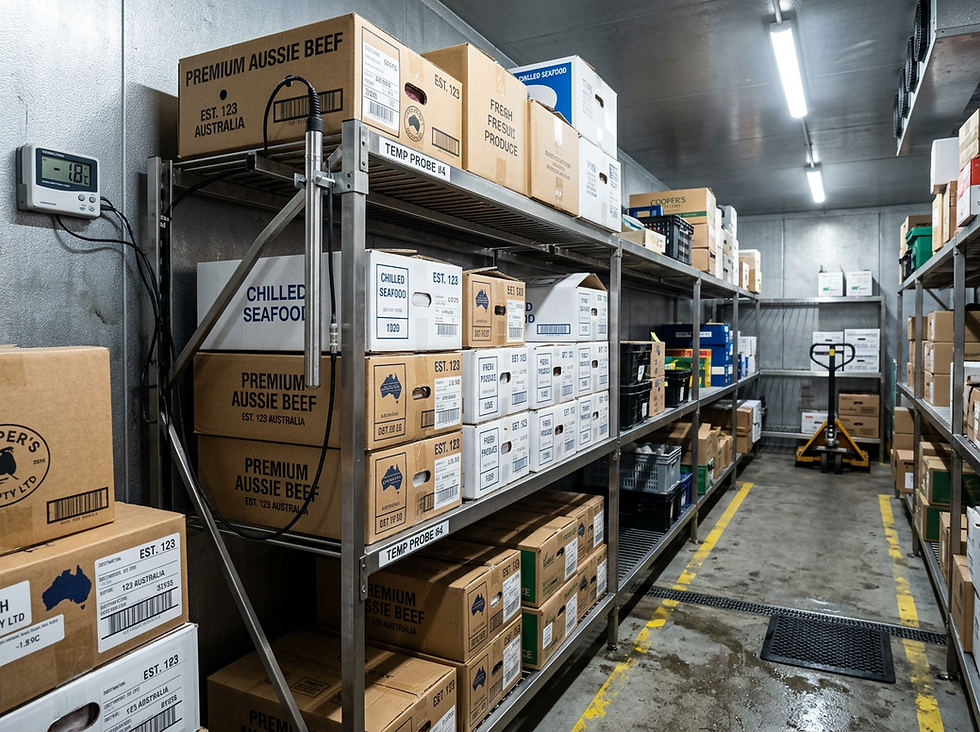
Cold-Room Temperature Mapping Before Monnit Sensor Installation
A temperature sensor can be accurate and still be in the wrong place. Coolroom doors, pallet stacks, evaporator fans, warm loading and defrost cycles can create different conditions within the same space. This engineering guide explains how to map a refrigerated room before choosing a permanent Monnit wireless probe position. The objective is representative measurements, reliable communications and a documented response plan, not an automatic claim of food-safety or medical compliance.
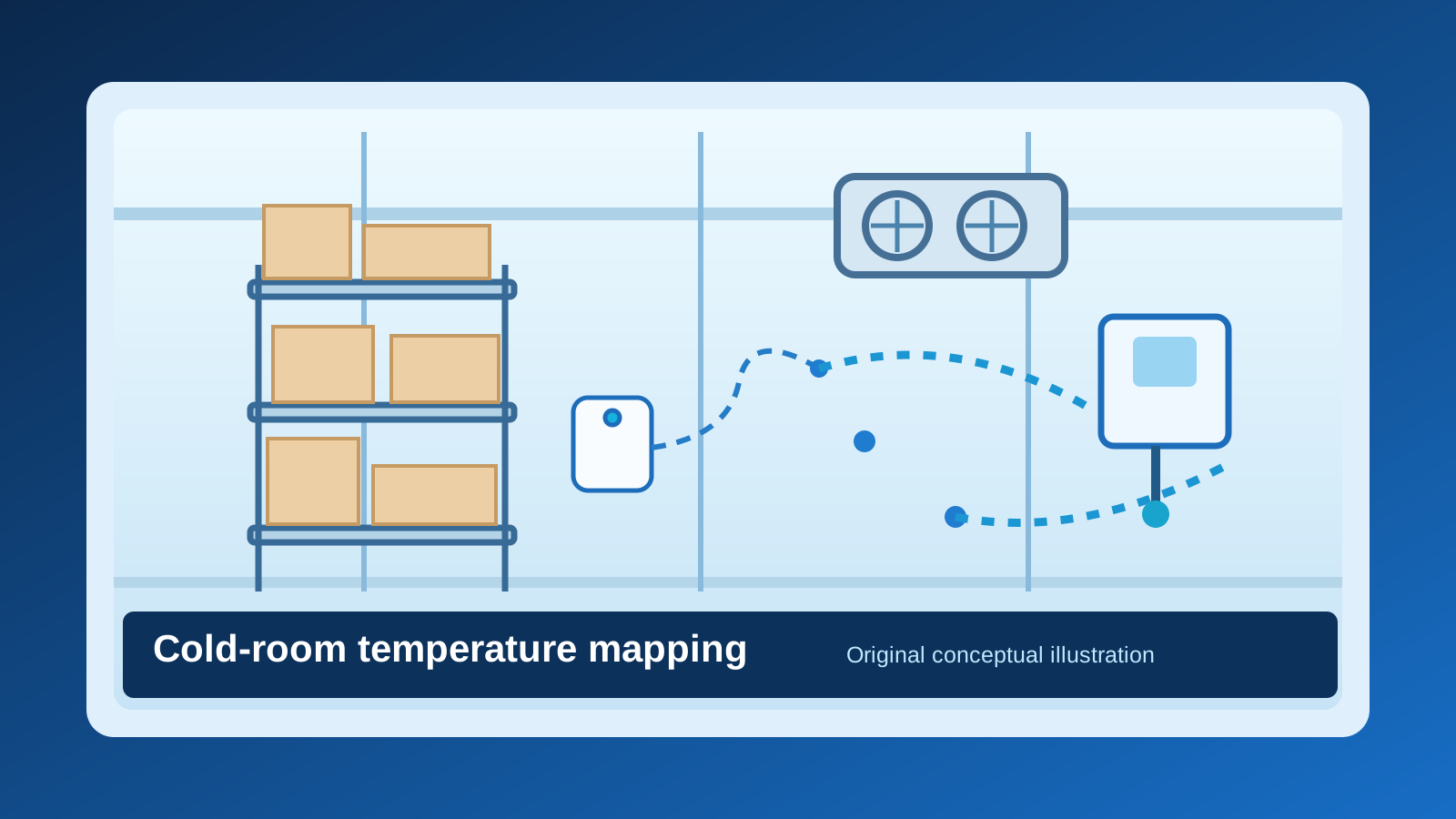
Key takeaways
Map several positions during normal operations before final installation. Decide whether the required measurement represents room air, a buffered response or stored goods. Confirm the leaded sensor model and its environmental limits, then validate gateway radio coverage and operational alarms separately.
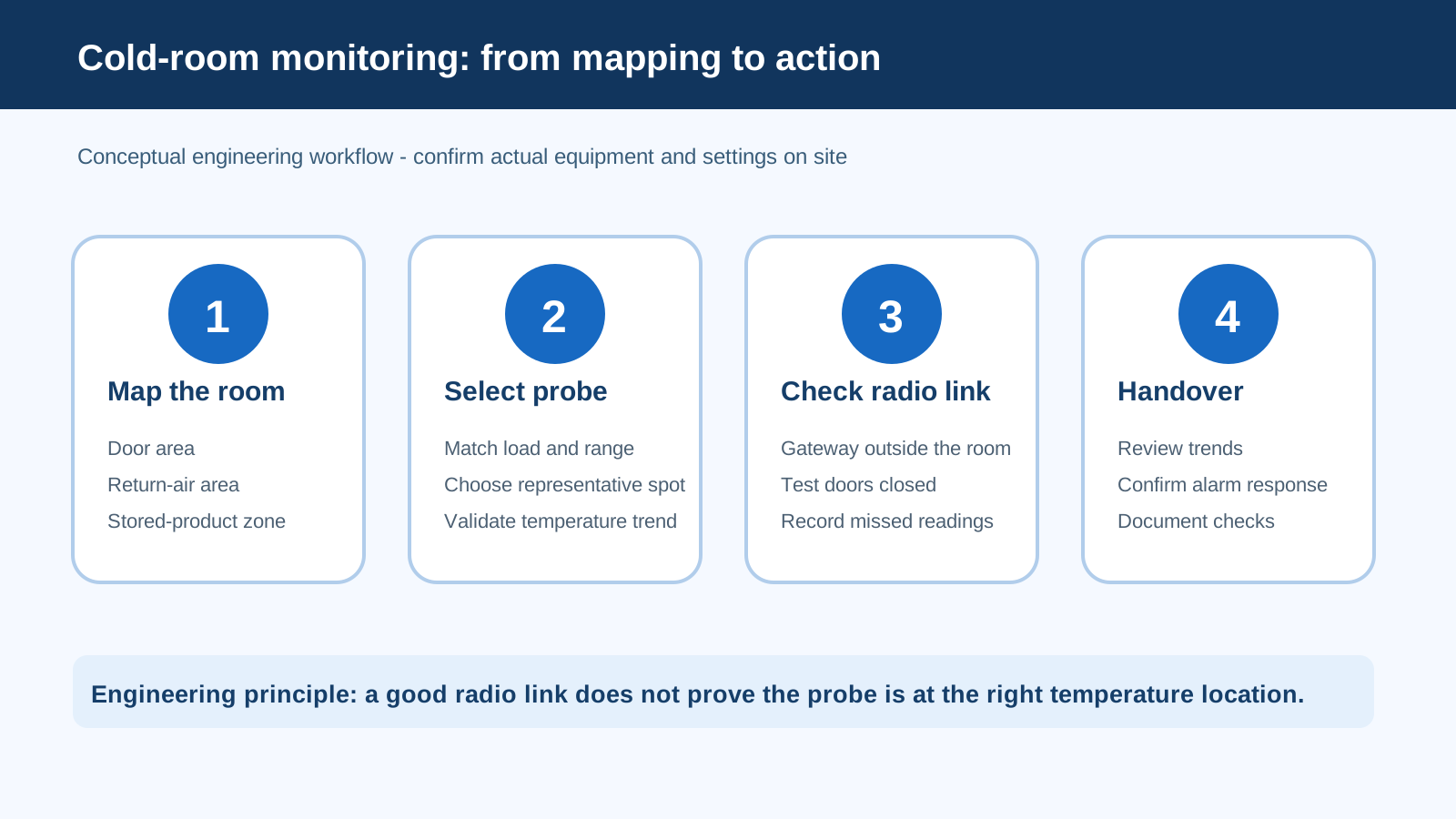
1. Define the measurement objective
First identify what the room holds and what decision a temperature excursion requires. Chilled ingredients, frozen packaged food and temperature-sensitive laboratory materials are not equivalent applications. Air near the door can warm rapidly during loading while densely packed product may change more slowly. Measuring the coldest air stream near an evaporator may hide a warmer storage zone.
Document the owner-approved storage range, required record interval, reporting responsibility, permissible response delay and escalation route. For vaccine and regulated medical storage, a qualified person must assess the governing storage, calibration and record-keeping requirements. A wireless sensor and dashboard alone are not proof of regulatory compliance.
2. Map the room before fixing the sensor
Use suitable temporary reference loggers, independently checked probes or a planned survey to compare plausible monitoring positions. Good candidates include the main product-storage zone, an area exposed to the loading door and a position influenced by evaporator airflow. Record each probe's location, height and reference-instrument status so later comparisons are meaningful.
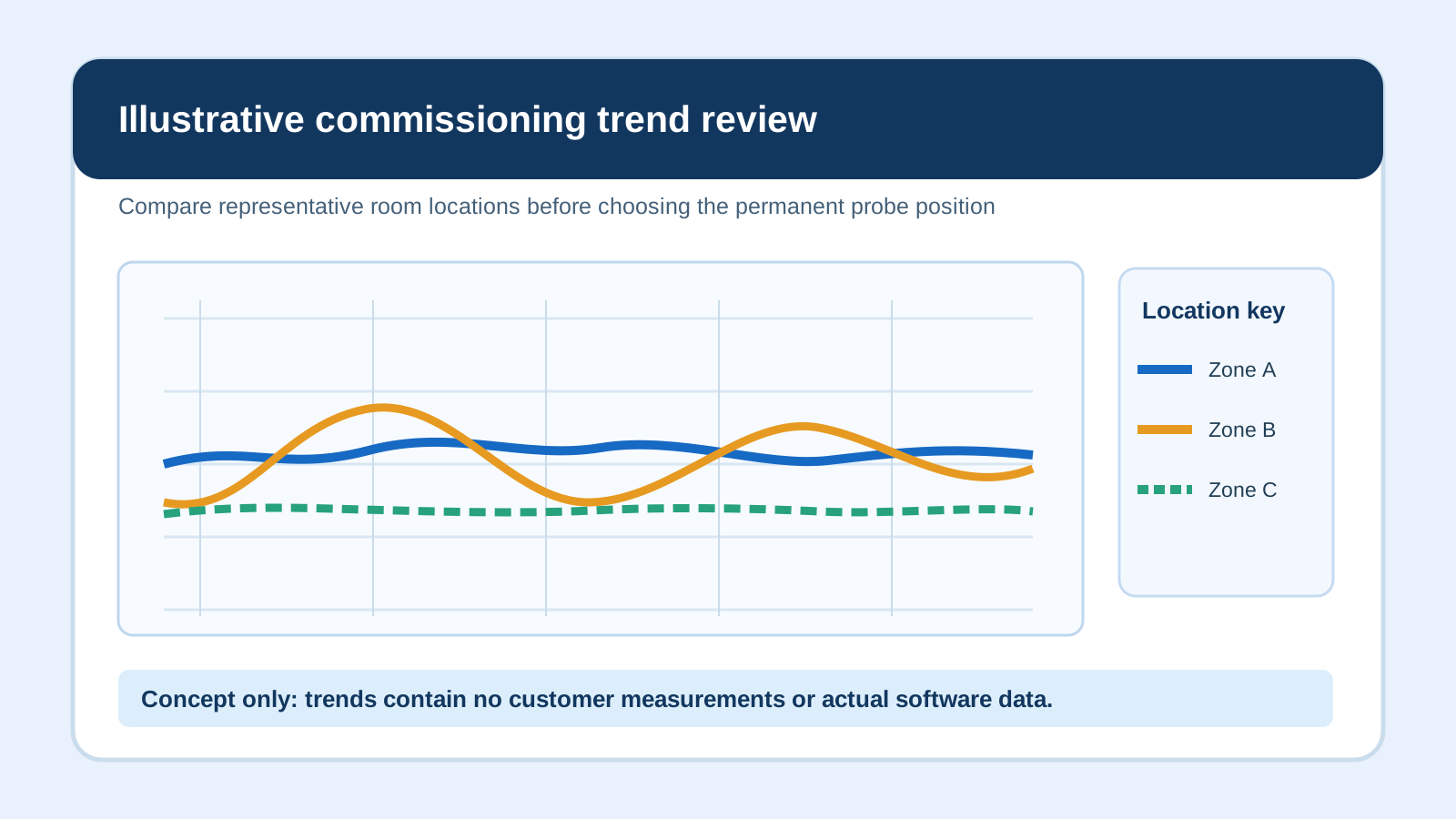
Observe normal loading, equipment operation and a representative defrost cycle. Use aligned timestamps and compare trends rather than snapshots. A location with brief door-related air spikes may be useful for a door-traffic study but not for representing bulk stored goods. Conversely, a return-air location may be useful for diagnosing refrigeration performance but not every pallet position.
3. Choose the permanent leaded probe and transmitter position
The current ProSense Solutions catalogue includes Monnit leaded temperature sensors and a commercial refrigeration monitoring kit with selectable gateway options. A leaded device can put its measuring tip inside the cold space while allowing the radio transmitter to be placed elsewhere when the model permits. Confirm the exact probe type, length, measurement range, mounting method, calibration and supplied options before choosing it.
Mount the tip clear of direct evaporator discharge, door seals, heater elements and surfaces that could distort the intended air measurement. Keep it accessible for cleaning and checking without putting it in the path of pallets, forklifts or stock movements. Never drill into a refrigerated cabinet or insulated panel without manufacturer approval and competent assessment of hidden refrigerant lines, electrical services and panel integrity.

For commercially available options, see the ProSense Wireless Commercial Fridge and Freezer Monitoring Kit and the Monnit leaded wireless temperature sensor range. These are current product listings, not claims that one option suits every storage environment.
4. Test the wireless link independently of temperature
A temperature reading can look plausible while radio communications are marginal. Refrigerated panels, steel racks and machinery can weaken or reflect radio signals. Monnit's ALTA architecture communicates directly between each sensor and its gateway; neighbouring sensors do not relay readings as a mesh. Published range figures assume favourable conditions and are not a commissioning guarantee in a metal-lined facility.
Check signal reliability with the doors closed, normal stock in place and equipment operating. Record missing reports and gateway connectivity as well as temperature. Test a gateway position outside the metal enclosure where practical, maintaining the device's environmental and electrical requirements. Follow the manufacturer's antenna-orientation guidance and consider the official ALTA Site Survey Tool in difficult buildings.
5. Separate defrost and doorway effects from genuine risk
Defrosting and loading may create short air-temperature excursions even when the refrigeration equipment is functioning normally. The monitoring design should recognise that operating pattern without concealing sustained warming that threatens stock. Review trend duration and location, then agree a threshold and response process suited to the stored materials.
A thermal buffer may be useful where an approved procedure calls for a slower temperature response, but Monnit accessories have model-specific compatibility. Do not fit a generic buffer or configure an arbitrary software delay merely to suppress notifications. Validate that the resulting measurement still answers the stated operational question.
6. Worked example: a dispatch coolroom
Imagine a refrigerated dispatch area with an evaporator at the rear, pallets in the central aisle and a frequently opened loading door. Temporarily compare three measurement positions during ordinary dispatch and a defrost cycle. This is a hypothetical layout, not a customer case study, and no measured temperatures are being represented here.
Suppose the doorway position changes sharply with traffic while the central storage position moves more gradually. The doorway is an operationally useful location but may be unsuitable as the sole permanent proxy for the storage zone. Repeat the monitoring comparison using the selected Monnit leaded probe at the chosen location, and add another point if separate questions remain.
7. Commissioning acceptance and handover checklist
Record the sensor and gateway model, identifier, probe mounting point, reference-instrument results, reporting interval and the ordinary operating conditions observed. Verify that the platform receives readings with doors closed and normal equipment running. Test a controlled alarm, then document who receives it, the expected response and the fallback process if communications are lost.
Review the location after major changes to room shelving, airflow, operating hours or refrigeration equipment. Inspect sensor mounts and cables as part of routine maintenance, and record how staff respond to missing data, battery warnings or unexpected excursions. A clear acceptance record is more valuable than a dashboard whose sensor positions have never been justified.
Common mistakes
Avoid selecting a location from a single handheld reading, placing all transmitters behind metal without a radio survey, assuming a buffered probe directly measures product core temperature, or treating a generic alarm limit as compliance advice. Validate the measurement, connectivity and human response as three separate parts of the solution.
For related guidance, read Designing Effective Wireless Coolroom Temperature Alarm Strategies and Why an External Temperature Probe Improves Wireless Freezer Monitoring. Those articles address alarm planning and freezer radio placement in greater depth.
Need help with your application?
ProSense Solutions helps Australian industry and facilities teams select application-specific monitoring equipment and kits. Review the current refrigeration monitoring kit or discuss your project and request a quote. Sharing the room layout, product-storage conditions, electrical and network arrangements and existing temperature records will help define a practical selection.
Primary manufacturer references
Monnit: fitting a leaded temperature sensor to a fridge or freezer; Monnit: gateway range and obstructions; Monnit: antenna orientation. Use the current document for the exact supplied model and regional variant.