.png)
Private LoRaWAN vs Direct 4G Sensors for Remote Asset Monitoring: Pros, Cons and Case Studies
Remote asset monitoring sounds simple until the assets are 80 kilometres from the nearest depot, scattered across paddocks, mines, pumps, tanks, waterways or access tracks. At that point, the network choice can decide whether a project works for years or becomes a maintenance burden.
Two common options are private LoRaWAN and direct 4G sensors. Both can send small packets of data from remote equipment to a cloud platform. Both can support alarms, trend data and condition monitoring. They solve the problem in very different ways.
Private LoRaWAN works best when many sensors sit within range of one or more gateways. Direct 4G works best when each asset needs its own independent path to the mobile network. The right answer often comes down to geography, density, power, installation effort and how much control the operator wants over the network.

How private LoRaWAN and direct 4G sensors differ
LoRaWAN is a low-power wide-area network protocol designed for small, infrequent messages. A sensor transmits data over unlicensed radio spectrum to a gateway. The gateway then sends the data to the internet through Ethernet, fibre, Wi-Fi, satellite or cellular backhaul.
In a private LoRaWAN deployment, the organisation owns or controls the gateways, network server and coverage plan. That can suit farms, utilities, councils, ports, mines and industrial sites where assets are clustered across a defined area.
Direct 4G sensors take a different path. Each device includes a SIM or eSIM and connects straight to a mobile network, often using LTE-M, NB-IoT or 4G Cat-1 depending on the device and coverage. The sensor does not need a local gateway. If it can reach the carrier network, it can send data.
The core difference is simple:
Private LoRaWAN | Direct 4G sensors |
Many sensors share one or more gateways | Each sensor connects to the mobile network |
Best for clustered assets | Best for scattered assets with coverage |
Very low sensor power use | Higher power use, though LTE-M and NB-IoT improve this |
Network control sits with the owner | Network coverage and service sit with the carrier |
Needs gateway planning and maintenance | Needs SIM management and carrier coverage checks |
Neither option is universally better. Private LoRaWAN can be excellent for a dense group of low-data sensors. Direct 4G can be the cleaner choice when assets are isolated, mobile or spread across a very large area.
The strengths and weaknesses of private LoRaWAN
Private LoRaWAN is attractive because one gateway can support many devices. In the right terrain, a gateway on a mast, silo, hill or building can cover a wide area. This makes it a strong fit for clustered monitoring.
Common use cases include:
Tank level sensors across a farm
Soil moisture probes in irrigation blocks
Pump run status and fault alarms
Gate, shed and equipment monitoring
Environmental sensors near waterways
Meter reading across a site or precinct
The biggest advantage is low device power. LoRaWAN sensors can often run for long periods on batteries because they transmit short messages and spend most of their time asleep. That matters when replacing a battery means a long drive, a safety permit or a technician callout.
Private LoRaWAN also gives the owner more control. The operator can decide where gateways go, how coverage is shaped and how data flows into their systems. There are no per-device cellular data plans, which can reduce operating costs when hundreds or thousands of sensors are involved.
The trade-off is that someone must design, install and maintain the network. Gateway placement matters. Terrain matters. Trees, sheds, tanks, machinery, hills and distance all affect performance.
LoRaWAN also has limits on data volume and message timing. It is not built for high-frequency telemetry, firmware downloads, images, audio or video. It suits small readings such as level, pressure, temperature, vibration flags, open or closed states and alarms.
Private LoRaWAN can struggle when assets are too far apart. If a gateway only serves one or two sensors in a remote location, the economic case weakens. At that point, a direct 4G sensor may be easier.
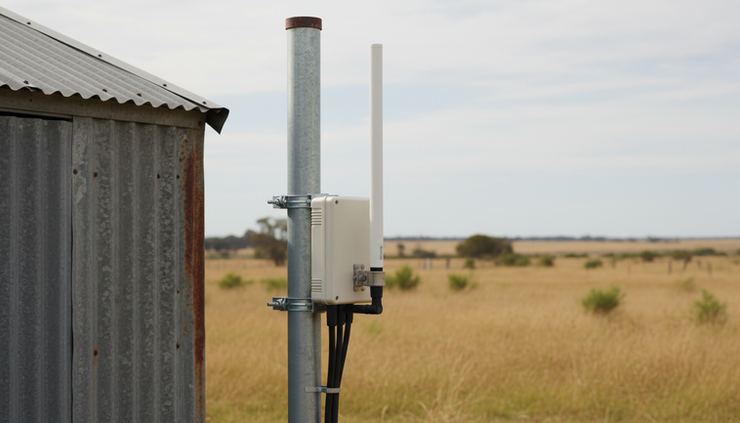
The strengths and weaknesses of direct 4G sensors
Direct 4G sensors are appealing because they avoid local network buildout. A device can be installed on a tank, generator, bore, gate, trailer or remote meter and connect straight to the mobile network.
This is useful when assets are geographically isolated. If a pumping station is 40 kilometres from the nearest cluster of devices, a LoRaWAN gateway may add cost and complexity. A 4G sensor with a good antenna may be the more practical choice.
Direct cellular devices also suit assets that move. A LoRaWAN sensor usually depends on being within range of a known gateway. A 4G tracker, fuel monitor or equipment sensor can report from different places as long as it has carrier coverage.
The other benefit is simpler responsibility. The mobile carrier operates the network. The project team does not need to own radio infrastructure beyond the device antenna. For small deployments, this can speed up rollout.
The disadvantages are clear.
Each sensor needs a SIM, data plan, provisioning process and ongoing account management. Costs can climb when the fleet grows. Power use is also higher than LoRaWAN in many real deployments, especially where signal strength is poor. A cellular sensor may use more energy as it searches for network, retries messages or transmits from a weak-coverage area.
Coverage is the main risk. A carrier map is a starting point, not a site survey. Remote gullies, metal enclosures, pump sheds, tree cover and terrain can create dead spots. External antennas help, but they add installation work.
Direct 4G sensors also depend on carrier decisions. Network changes, SIM policies, roaming arrangements and technology retirement plans can affect long-life deployments. This is less of a concern with current LTE-based services than with older 2G and 3G networks, but lifecycle planning still matters.
Clustered LoRaWAN deployments can beat cellular at scale
The strongest case for private LoRaWAN is a cluster of assets that are close enough to share gateways.
Think of a large vineyard, cattle property, water treatment site, distribution depot, university campus, mine village, marina or council works precinct. The assets are spread out, but not randomly across the country. In this model, a small number of gateways can serve many sensors.
That changes the economics. The gateway cost gets spread across the fleet. The sensors can be cheap, simple and low power. The owner can tune the network for local needs.
A clustered private LoRaWAN design often works well when:
Device count is high
Messages are small
Data is needed every few minutes or hours, not every second
Assets sit inside a known area
The site has at least one good point for gateway mounting
There is power and backhaul at the gateway location
The operator wants long battery life
A common example is water monitoring on rural properties. Multiple tanks, troughs, bores and pumps may sit across the property. Installing a cellular device at every point can mean many SIMs and higher battery use. A private LoRaWAN gateway on a homestead, hill, silo or repeater point can collect readings from many battery sensors.
Another example is a council flood-monitoring cluster. Sensors at culverts, drains and creek crossings can send water-level readings through gateways mounted at council buildings, depots or elevated public infrastructure. The data volume is small, and alarms matter more than rich media. LoRaWAN is well matched to that pattern.
The weak point appears when the cluster breaks apart. If one sensor sits far beyond the existing LoRaWAN coverage, adding a gateway just for that single asset may not make sense. Cellular can fill that gap.
Direct 4G sensors often win for isolated assets
A direct 4G sensor looks expensive when compared with a simple LoRaWAN node, but the full system cost can tell a different story.
For a lone asset, LoRaWAN needs the sensor plus a gateway, power for the gateway, backhaul, mounting hardware, site access and support. If there are no nearby assets to share that gateway, the network cost has nowhere to spread.
Direct 4G sensors are often a better fit for:
Remote pump stations
Single tanks on distant properties
Off-grid generators
Roadside signs and traffic equipment
Isolated weather stations
Rail corridor cabinets
Temporary construction assets
Mobile equipment and trailers
In these cases, the device is its own communications system. If there is usable coverage, installation can be much simpler. The sensor may send a daily heartbeat, event alarms and trend data without any local gateway.
This is why many remote monitoring projects use a mixed model. LoRaWAN handles the dense sites. Cellular handles the outliers.

Case studies that show the trade-offs
Real deployments rarely match neat diagrams. These examples show how the decision changes with asset spacing, terrain and maintenance needs.
Case study one shows why farms often choose private LoRaWAN
On many Australian farms, the assets needing monitoring are spread across the property but still form a cluster. Tanks, troughs, pumps and soil moisture probes may sit kilometres apart, yet within reach of a well-placed gateway.
A typical design places a LoRaWAN gateway at the homestead, machinery shed, hilltop or tower. Battery-powered sensors then report water levels, pump state, pressure or soil readings.
This approach can reduce routine inspection trips. Instead of driving to each tank, the operator receives alerts when levels fall or a pump fails. The data payloads are tiny, so LoRaWAN suits the use case.
The risk sits in coverage planning. A trough below a ridge or behind dense trees may not report reliably. Good projects test signal strength before committing, then adjust antenna height or add a second gateway where needed.
The lesson is clear. Private LoRaWAN works well when many low-power sensors can share coverage, but the radio design cannot be guessed from a map.
Case study two shows why water utilities use both models
Water utilities often manage a mix of dense and isolated assets. A treatment plant may have many sensors within a fenced site. A reservoir, pressure reducing valve or remote sewer pump station may sit by itself.
Inside the plant, private LoRaWAN can collect readings from meters, chemical storage areas, gates, environmental points and equipment rooms. The site can host gateways with mains power and reliable backhaul.
For the isolated reservoir, direct 4G may be simpler. Installing a private gateway for one or two instruments could be harder to justify, especially if the site already has cellular coverage and a solar power system.
This split model is common in practice. The network is chosen per asset group, not across the whole organisation as a single rule.
The lesson is that hybrid architecture often beats a one-network policy.
Case study three shows why cellular suits transport and mobile assets
Transport and logistics assets do not stay inside a private radio footprint. Trailers, portable generators, roadwork equipment and hire assets may move across regions. LoRaWAN can work at depots or yards, but it cannot report from areas without gateways.
Direct 4G trackers and sensors suit this pattern because they follow the asset. The device can report location, battery state, usage hours, impact alerts or fault conditions wherever the mobile network is available.
A rental equipment business, for example, may use cellular trackers on pumps, lighting towers or generators. The devices report when assets move, where they are parked and whether they are being used. A private LoRaWAN network would only cover company-controlled yards, not customer sites.
The lesson is that mobility strongly favours cellular.
Case study four shows why isolated environmental monitoring is harder
Environmental monitoring often happens in awkward locations: creek banks, wetlands, fire trails, coastal zones and remote catchments. The data may be simple, such as rainfall, water level, temperature or salinity. LoRaWAN suits the payload, but not always the geography.
If several sensors sit along a valley and a gateway can be mounted high above them, private LoRaWAN can work well. If the sites are scattered across separate catchments, each with poor line of sight, direct 4G or satellite backhaul may be more practical.
Field access also matters. A LoRaWAN gateway on a hill may need power, lightning protection, a secure mount and backhaul. A cellular sensor at the measurement point may need only a pole, antenna and solar panel.
The lesson is to model the full site visit and maintenance load, not just radio range.

A practical decision framework
A good network decision starts with the asset map. Before comparing devices, list every monitoring point and group them by location, power access, data need and maintenance difficulty.
Use these questions to guide the choice.
Question | LoRaWAN points to | 4G points to |
Are many sensors within one area? | Yes | Not required |
Are assets isolated from each other? | Less suitable | Strong fit |
Is battery life critical? | Strong fit | Depends on signal and reporting rate |
Is mobile coverage reliable on site? | Helpful for gateway backhaul | Required |
Is the data payload small? | Strong fit | Also suitable |
Is the asset moving? | Only inside coverage | Strong fit |
Is local network control needed? | Strong fit | Limited |
Is fast rollout for a few sites needed? | Sometimes | Strong fit |
The cost model should include more than hardware. For LoRaWAN, include gateways, masts, power, backhaul, survey time and support. For 4G, include SIMs, data plans, antennas, carrier management and battery replacement.
Power modelling deserves special care. A 4G sensor in strong coverage may perform well for a long time. The same device in weak coverage may drain far faster. A LoRaWAN sensor may last well in normal conditions, but poor radio design can also cause retries and missed messages.
Security is another factor. Private LoRaWAN uses device keys and network controls, while cellular uses SIM-based authentication and carrier infrastructure. Both can be secure when configured well. The bigger risks often come from poor device management, weak passwords, exposed dashboards and missing update processes.
When a hybrid network is the best answer
The most effective remote monitoring systems often use both technologies.
A private LoRaWAN network can cover dense zones such as farms, plants, yards, precincts and campuses. Direct 4G sensors can cover isolated points, moving equipment and locations where a gateway would be wasteful.
This mixed design avoids forcing one technology into the wrong job. It also gives operators a staged path. Start with cellular sensors to prove the monitoring use case. Add LoRaWAN when sensor count grows in a defined area. Keep cellular for the outliers.
That approach supports scale without locking every asset into the same communications pattern.
Private LoRaWAN vs Direct 4G Sensors for Remote Asset Monitoring is not a choice between old and new, or cheap and expensive. It is a choice between shared local coverage and independent wide-area connectivity.
For clustered low-power sensors, private LoRaWAN can be hard to beat. For isolated or mobile assets with usable mobile coverage, direct 4G is often simpler and more reliable to deploy. For many real-world projects, the strongest answer is both, used where each one makes technical and commercial sense.


