.png)
LoRaWAN vs Wi-Fi and Cellular for Large Outdoor Site Monitoring
A sensor network that works well in a plant room can fail badly once it is spread across paddocks, tailings areas, pump stations, depots or treatment ponds. Distance changes the design. So do dust, steel structures, tree cover, terrain, power access and the cost of sending small packets of data all day, every day.
For large outdoor sites, the question is rarely “which wireless technology is best?” A better question is: which architecture matches the job?
Wi-Fi, cellular and LoRaWAN all have a place. Wi-Fi suits high-data local networks. Cellular is useful where public coverage is strong and sensor numbers are modest. LoRaWAN makes sense when many low-power sensors need to report small amounts of data across a wide area without constant battery changes or monthly SIM costs for every device.
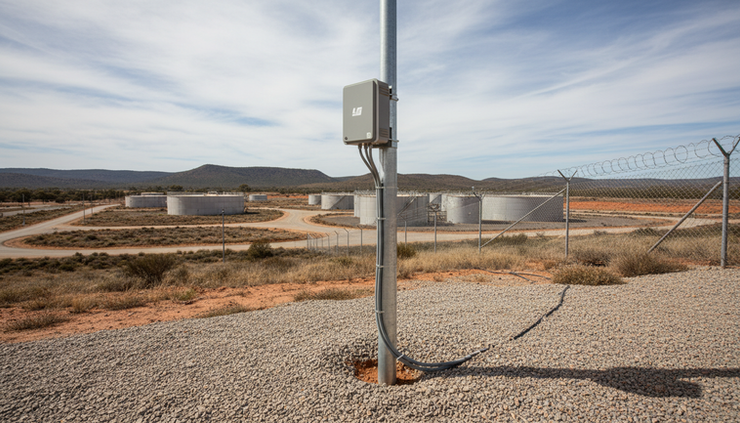
The real difference is the network shape
Wi-Fi, cellular and LoRaWAN are not just different radios. They create different network shapes.
Wi-Fi normally works as a local network. Devices connect to access points, then backhaul traffic through fibre, ethernet, mesh links or another service. It can carry high data rates, which is why it suits cameras, tablets, laptops and local control systems. The trade-off is coverage. Outdoor Wi-Fi needs power, mounting locations, careful channel planning and often many access points.
Cellular uses the mobile network. Each sensor usually has its own modem and SIM or eSIM. This avoids building local radio coverage, provided the mobile signal is good. It suits assets that move between sites, remote equipment that reports occasionally, or applications where data volumes justify the service cost.
LoRaWAN uses a star-of-stars model. Sensors send small packets over long-range radio to one or more gateways. The gateways forward data to a network server, usually over ethernet, cellular or another internet link. From there, the data moves into dashboards, alerts, databases or control systems.
That architecture matters because a gateway can serve many sensors. The sensors do not need to negotiate Wi-Fi sessions or maintain power-hungry cellular links. They wake, transmit, receive if needed, then sleep.
For large outdoor monitoring, that simple pattern is valuable.
Where LoRaWAN tends to beat Wi-Fi
Wi-Fi was built for local area networking. It is excellent when devices need speed and low-latency access within a defined zone. Around workshops, site offices, control rooms, warehouses and amenity areas, it can be the right choice.
It becomes harder outdoors when the monitored points are spread out.
A mine site may need level, vibration or environmental sensors across stockpiles, workshops, haul roads and water management areas. A farm may need soil moisture readings across paddocks, dam level alerts and weather data at exposed locations. A council may need bin fill, flood level or park irrigation data across suburbs. A wastewater facility may need monitors around ponds, pump stations, chemical storage and outfalls.
In those cases, the Wi-Fi design can grow quickly:
More access points
More poles and enclosures
More power supplies or solar kits
More backhaul links
More maintenance points
More radio planning
LoRaWAN changes that balance. A small number of well-placed gateways can often cover broad outdoor areas, depending on terrain, antenna height, obstructions and local radio conditions. The data rate is much lower than Wi-Fi, but many site-monitoring tasks do not need speed. They need a reading every few minutes, every hour or when a threshold changes.
That makes LoRaWAN a strong fit for:
Tank and dam levels
Soil moisture
Rainfall and weather stations
Gate, hatch and lid status
Pump run status
Flow and pressure trends
Temperature and humidity
Asset location within a site
Leak, flood or overflow alerts
Energy and water metering
If the device only sends a few bytes at a time, Wi-Fi can be more network than the task needs.

Where LoRaWAN tends to beat cellular
Cellular sensors are simple to understand. If there is mobile service, the device can connect directly to the cloud. That can be a good fit for small fleets or widely scattered assets.
The costs and power draw can become a problem when sensor numbers rise.
A wastewater authority might have dozens of pump stations and hundreds of instruments. A council might want water level sensors across creeks, gross pollutant traps and drainage assets. A large agricultural operation may want hundreds of soil and water points. An industrial campus may want many condition and utility readings around the site boundary.
With cellular, every remote sensor may need:
A modem
A SIM plan
Provisioning and account management
Coverage checks
Higher peak power
Firmware and carrier compatibility management
LoRaWAN moves much of that complexity into the gateway layer. Sensors use low-power radio, while gateways handle the internet connection. A site may still use cellular backhaul, but it is fitted to gateways rather than every sensor.
This can reduce communications costs where there are many low-data devices. It can also improve battery life because LoRaWAN sensors can spend most of their lives asleep.
Cellular still wins in some cases. If a remote asset sits far outside any practical gateway coverage, a cellular sensor may be cheaper than building coverage. If the device needs frequent large data transfers, cellular may be a better match. If the asset moves long distances, such as trucks or hire equipment, cellular is often simpler.
The key is to avoid paying for a full mobile data service when the sensor only needs to say “level is 63 per cent” or “gate opened” a few times a day.
Gateways are the centre of the LoRaWAN design
A LoRaWAN gateway is not just a stronger access point. It listens for LoRaWAN sensor messages and forwards them to a network server. Sensors are not paired to one gateway in the same way a device joins a Wi-Fi access point. If several gateways hear the same message, the network server can process duplicates and keep the best copy.
This gives LoRaWAN useful site behaviour. Extra gateways can add coverage, improve reception or increase resilience without changing every sensor.
A practical gateway design looks at:
Height
A gateway mounted high on a building, pole, silo or tower usually sees more of the site. Height can matter more than transmitter power.
Line of sight
Open areas are easier. Earthworks, tanks, metal buildings, dense vegetation and hilly ground can create shadows.
Backhaul
Each gateway needs a path back to the network server. That may be ethernet, fibre, Wi-Fi bridge, private radio or cellular.
Power
Mains power is best where available. Solar can work well when the site has good sun exposure and the load is planned carefully.
Antenna placement
Good antennas still perform poorly if mounted against metal, inside cabinets or too close to electrical noise.
Redundancy
Critical sites may use more than one gateway so a single fault does not silence the network.
For mines, farms and council assets, a coverage survey or staged pilot often gives better answers than a coverage claim on paper. Start with the most difficult locations, not the easy ones near the workshop.
Coverage improves when the data is modest
LoRaWAN reaches long distances by using low data rates and radio modulation designed for sensitivity. That comes with limits. It is not suitable for live video, high-frequency vibration waveforms or large file transfers. It is designed for small payloads.
That makes it well suited to outdoor monitoring because many site data points are slow-changing. A tank level does not need to report every second. A rainfall gauge can report tips as events. A soil probe can report at intervals. A pump status sensor can send state changes plus a regular heartbeat.
The design should set reporting intervals based on need, not curiosity.
For example:
Monitoring task | Sensible reporting pattern | Why it suits LoRaWAN |
Soil moisture | Periodic readings through the day | Small payloads and long battery life |
Dam or tank level | Regular reports plus high and low alerts | Slow-changing data with useful exceptions |
Gate or hatch status | Event message plus daily heartbeat | Very low data volume |
Weather station | Scheduled readings and rain events | Remote placement with modest data |
Pump station status | State changes and periodic health checks | Useful alerts without heavy traffic |
This approach also protects network capacity. LoRaWAN can support many devices, but airtime is shared. A well-designed network keeps messages short, intervals sensible and retries under control.

Battery life depends on the whole application
LoRaWAN is often associated with long battery life. That is fair, but battery life is not automatic. It depends on the sensor, measurement type, reporting interval, radio conditions and temperature.
A dry-contact gate sensor that sends rare events can run for a long time. A sensor that powers a probe, heats an element, logs frequently or transmits often will use more energy. Poor radio coverage also hurts battery life because messages may need higher spreading factors or retries.
Good battery outcomes come from design choices:
Use event-based reporting where it makes sense
Keep routine reporting intervals realistic
Mount antennas properly
Place gateways to reduce difficult transmissions
Choose sensors with sleep modes that match the job
Avoid sending repeated “nice to know” data
This is one reason LoRaWAN is attractive for farms, environmental monitoring and large utility sites. Changing batteries across a few locations is manageable. Changing them across hundreds of scattered points can become a real operating cost.
Battery planning should include access conditions. A sensor on a tank beside a sealed road is one thing. A sensor in a flood-prone easement, a remote paddock or a restricted industrial zone is another.
Sensor density cuts both ways
LoRaWAN can handle high sensor counts across large areas, but it is not limitless. It performs best when many devices send small, infrequent messages. It performs poorly if every device sends too often, sends large payloads or asks for many confirmed messages.
Wi-Fi has a different density problem. It can move more data, but coverage cells are smaller and shared bandwidth can suffer when many devices connect in one area. It also requires stronger power support at the device end.
Cellular avoids local shared gateway capacity, but each added device adds service management and often a recurring cost.
A practical rule is simple:
Wi-Fi suits dense zones with power and higher data needs.
Cellular suits isolated or mobile assets with public coverage.
LoRaWAN suits many fixed, low-data outdoor sensors.
For an industrial campus, this may mean Wi-Fi around buildings, private ethernet for critical plant, cellular for mobile equipment and LoRaWAN for distributed meters, environmental sensors and boundary assets.
Mixed networks are normal. The best architecture does not force one technology into every role.
Communications costs are more than data plans
The cheapest sensor network is not always the one with the cheapest device. Total cost includes installation, power, mounting, coverage checks, SIMs, gateway backhaul, maintenance and support.
Wi-Fi costs often appear in infrastructure. Outdoor access points need power, protection, mounts and backhaul. Cellular costs often appear in recurring services and device management. LoRaWAN costs often sit in gateways, network server setup and integration, while individual sensors can remain low-power and low-data.
For large outdoor sites, the economics can shift quickly as sensor count rises.
A farm with five monitoring points may use cellular devices without concern. At 100 points, a gateway-based model starts to look different. A council running a small pilot may start with cellular water-level sensors. If the project expands across many drains, parks and depots, LoRaWAN can reduce the need for a service plan on every endpoint.
A mine or industrial campus may value control even more than direct cost. A private LoRaWAN network can keep coverage design, device onboarding and data paths under site management. Data can still flow to cloud platforms, SCADA interfaces or local systems, but the radio layer is not tied to one carrier’s coverage at every sensor.
How LoRaWAN fits different outdoor sites
Mines
Mines often combine distance, dust, vibration, changing terrain and restricted access. LoRaWAN can suit environmental monitoring, water assets, stockpile readings, bore levels, gate status and workshop utilities. It is less suited to high-speed machine telemetry or video.
Gateway placement should account for pit walls, haul road changes, metal structures and future site works.
Farms
Farms are a natural fit for low-power, long-range sensing. Soil moisture, weather, rainfall, trough levels, tank levels, pump status and gate alerts often need modest data but broad coverage.
Solar gateway sites, antenna height and practical service access matter. A good farm design keeps sensors simple and avoids over-reporting.
Wastewater facilities
Treatment plants and pump networks often have harsh locations and many distributed assets. LoRaWAN can report levels, overflows, pump status, access lid movement, gases where suitable sensors are used, and environmental conditions.
Gateway and sensor hardware must match the conditions. Enclosures, corrosion exposure and safe access matter as much as radio coverage.
Councils
Councils tend to monitor many public assets across wide areas. Creek levels, stormwater points, irrigation, public bins, facilities, depots and environmental sensors can all fit a low-data model.
LoRaWAN can be deployed as council-owned coverage, shared gateway coverage or a staged network built around priority zones.
Industrial campuses
Large campuses often already have ethernet, Wi-Fi and control networks indoors. LoRaWAN can fill the outdoor gaps where cabling is costly and Wi-Fi coverage is patchy. Common examples include utility metering, tank farms, perimeter assets, weather, laydown yards and non-critical condition monitoring.
Dragino and the ProSense open IoT portfolio
Dragino is a recognised maker of LoRaWAN gateways, nodes and sensor hardware used in open IoT projects. Within the ProSense open IoT portfolio, Dragino can form part of a practical building-block approach: gateways, field sensors, network services and data integrations selected to match the asset rather than locked into one closed stack.
That open approach matters for large outdoor sites. Mines, farms, utilities and councils rarely have one system. They have SCADA, cloud dashboards, spreadsheets, maintenance systems, alarms and local procedures. A useful IoT architecture needs to pass data into the tools that already run the site.
With LoRaWAN, Dragino devices can support pilots and larger rollouts where the task suits low-power, long-range sensing. They are not the answer to every monitoring problem, and they should be chosen against the same criteria as any field device: enclosure rating, sensor accuracy, power setup, antenna options, integration path and support needs.
The value is choice. ProSense can combine Dragino LoRaWAN hardware with other open IoT components so each site gets the right mix of sensors, gateways and data handling.

The best choice is usually a mixed architecture
LoRaWAN vs Wi-Fi and Cellular for Large Outdoor Site Monitoring is not a winner-takes-all decision. Each network has a clear role.
Use Wi-Fi where devices need higher data rates and local coverage is practical. Use cellular where assets are isolated, mobile or outside gateway reach. Use LoRaWAN where many fixed outdoor sensors need long range, low power and modest data.
For many large sites, the best design starts with the data:
What needs to be measured?
How often does it need to report?
What happens if a message is missed?
How hard is the sensor to reach?
Is power available?
How many similar sensors will exist in two years?
Where can gateways be mounted and powered?
When most answers point to small messages, broad coverage, battery operation and growing sensor counts, LoRaWAN often makes more sense than Wi-Fi or cellular. Build the network around that reality, and the monitoring system becomes easier to scale, easier to maintain and better matched to the site itself.


